

Large early-stage rounds attract attention to the capital. The deeper story sits in the operating sequence that precedes them: machines, crews, jobsites, partners, hiring and geography. Reconstructing that sequence shows how three companies reached the same financing stage through very different forms of proof.
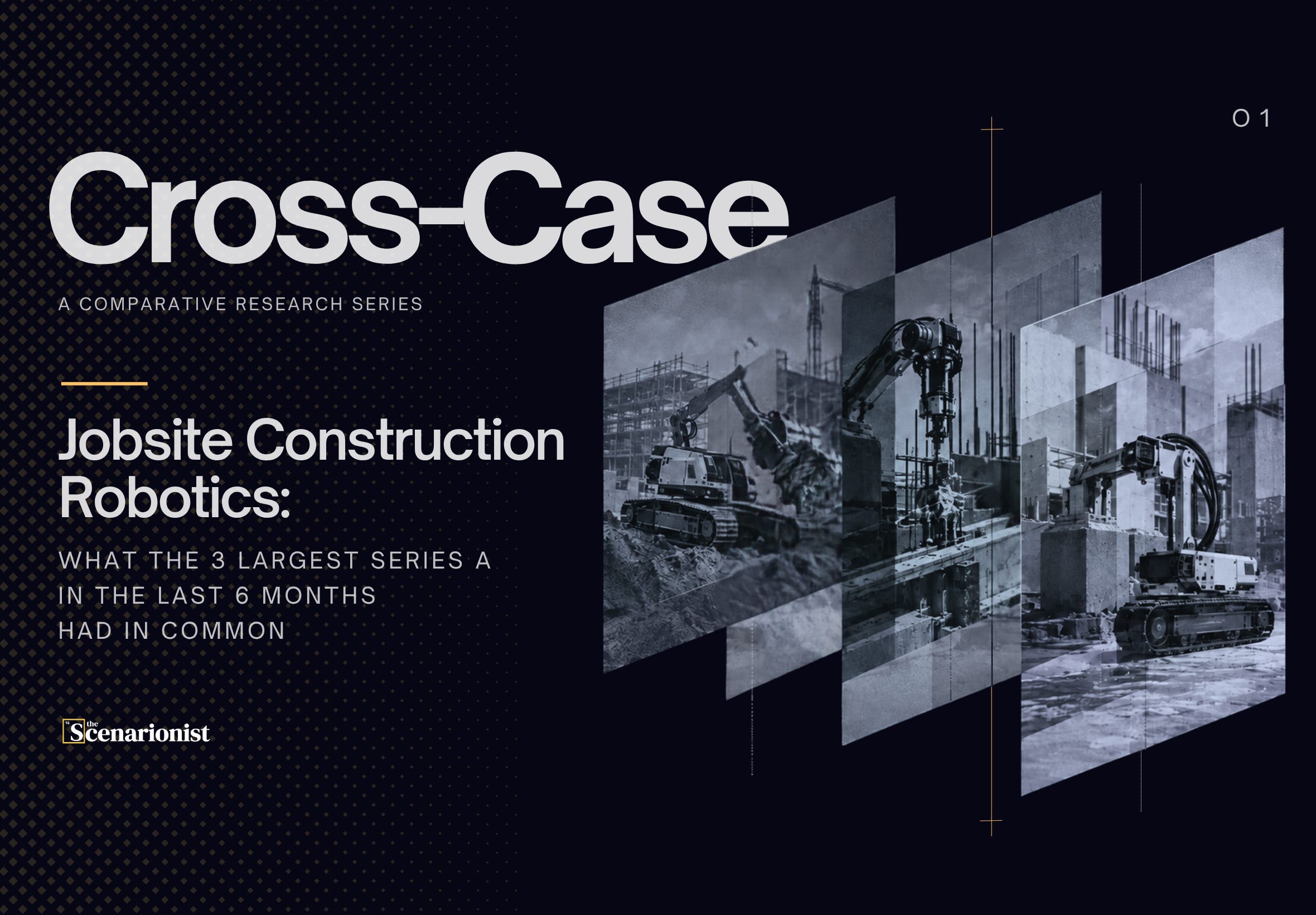
A Series A announcement compresses years of company-building into a date, a check and a list of investors.
Construction robotics makes that compression especially severe. Hardware has to survive open-air sites, integrate with equipment already on the ground, work around crews and safety rules, and produce evidence that can travel from one project to the next.
During a 35-day window in 2026, three jobsite robotics companies reached Series A with rounds ranging from $26 million to $200 million.
The category was shared.
The operating histories were very different.
One company grew out of academic field robotics and spent years integrating autonomy across multiple OEMs. Another came from aerospace engineering and built a construction operator around its own robotic stack. The third entered through a tightly defined solar workflow, with robots already working in the field and a substantial contracted pipeline.
These three companies form the cohort for the first edition of Cross-Case, a new comparative research format The Scenarionist is experimenting with.
Cross-Case examines companies, technologies and strategies side by side, exploring the technical, commercial and financial decisions behind their development. The aim is to identify patterns, meaningful differences and operating questions that individual cases rarely reveal.
The timing makes this first comparison particularly interesting.
Construction entered 2026 with persistent labor pressure, significant infrastructure demand and growing investment in physical AI. Against that backdrop, three major rounds could appear to tell the same story. Their operating histories suggest otherwise.
How did technical credibility develop? What gave each company access to the people, equipment and customers needed for deployment? And how did those choices shape the cost and complexity of scaling?
This first edition reconstructs the paths behind those three rounds, from founding teams and operating milestones to geography, commercialization, and capital formation. The comparison reveals what each company had established before Series A, where their strategies diverged, and which questions will define the next stage of growth.
Go beyond the funding announcements.
The full Cross-Case analysis brings together the three companies’ timelines, their capital formation pathways, the evidence of their progress, and the operating metrics that will matter as they scale.
The complete Cross-Case edition is part of The Scenarionist Premium.
Built around the questions that shape Deep Tech development, Premium brings together company case studies, exit analyses, techno-economic insights, industrial scaling frameworks, industry rumors, and execution lessons from more than 100 Deep Tech founders and investors.
Research and expert perspectives on the technological, commercial, and financial forces shaping emerging industries.