

✨ This is the Premium Edition of The Scenarionist. Unlock the full experience by becoming a Premium Member!
The Scenarionist Premium is designed to make you a better Deep Tech Founder, Investor, and Operator. Premium members gain exclusive access to unique insights, analysis, and masterclasses with the wisdom of the world’s leading Deep Tech thought leaders. Invest in yourself, and upgrade today!
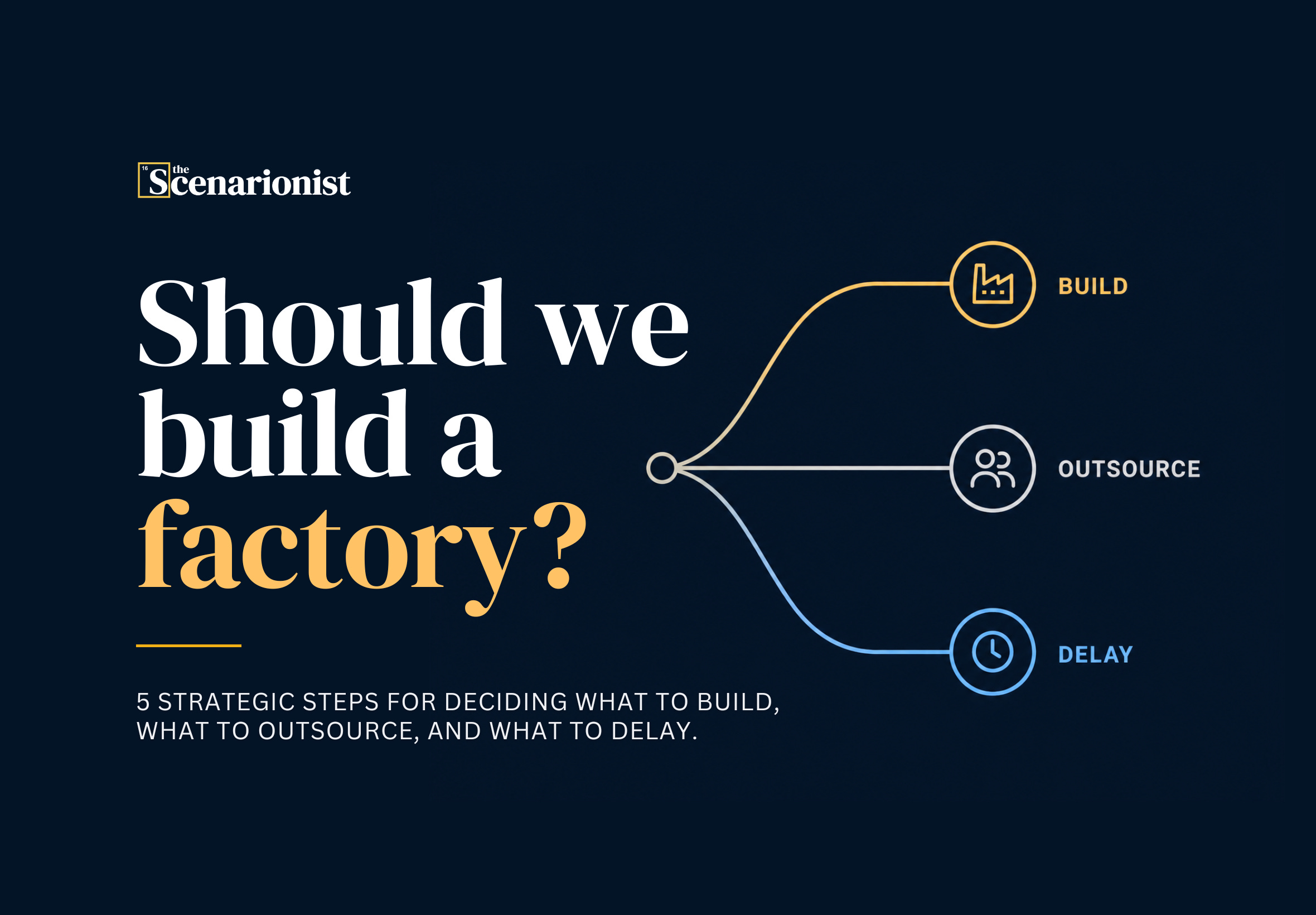
Dear Friends,
There is a question in Deep Tech that often appears much later than it should.
“Which parts of manufacturing should we actually own?”
At first, it sounds like an operational question.
Something to discuss with the technical team, the COO, the supply chain people, the contract manufacturers, the equipment vendors, or whoever is responsible for turning prototypes into something that can actually be delivered.
But the more I speak with founders, investors, and operators across Deep Tech, the more convinced I become that this is not really an operational question.
It is a company-design question because, among other things, it affects:
How much capital the company needs.
How fast it can reach the market.
How much margin it can capture across the value chain.
How defensible the business becomes.
How much control it has over quality.
How dependent it becomes on partners.
How credible it looks to customers.
And, consequently, the roadmap it follows and the type of company it ultimately becomes.
However, over time, markets change, supply changes, and regulation changes. That makes the manufacturing decision an evolving scenario that becomes true when the evidence catches up — a kind of Rubik’s Cube where several dimensions have to fit together within a specific window of time.
One recurring pattern across geographies and sectors is that the manufacturing conversation tends to become too binary, too quickly.
On one side, there is the asset-light instinct.
Stay flexible. Preserve capital. Leverage partners. Avoid building steel too early. Do not become a factory before the market is ready.
On the other side, there is the control instinct.
Own the process. Protect the know-how. Learn faster. Improve yield. Control quality. Do not let a third party become the place where the real manufacturing intelligence accumulates.
Both instincts are reasonable. And both can be dangerous.
A Deep Tech company that builds too early can trap itself in fixed costs before demand is real.
It can raise expensive equity to finance equipment, facilities, operators, permitting, and working capital, only to discover that customers are still testing, still qualifying, still comparing, still waiting.
But a company that outsources too casually can create a different kind of problem.
It may lose the learning loop that makes the product better. It may hand over know-how before it knows what is truly proprietary. It may become dependent on a partner that does not move at startup speed. It may struggle to control quality, cost, or yield.
This is the real pain.
Deep Tech companies are often told to scale, but not always given a clear way to decide what scaling should mean.
They are told to be capital-efficient, but also to prove they can deliver.
They are told to avoid CapEx, but also to show a credible path to commercial production.
They are told to leverage partner relationships, but also to protect their moat.
They are told to move fast, but also to build trust with customers who cannot afford supply risk.
And so the manufacturing question becomes a place where many unresolved tensions collide.
It is not just: “Should we build a factory?”
It is:
What does the customer actually need to believe before adopting this product?
What part of the value chain creates the real advantage?
Is demand strong enough to justify capacity?
Would CapEx create capacity?
Can partners help the company move faster without absorbing the knowledge that makes it valuable?
That is the kind of decision logic I want to unpack in this piece.
Spoiler alert: There is not one answer.
A robotics company, a semiconductor company, a battery company, a bio-manufacturing company, an aerospace company, and a photonics company will not make the same manufacturing decision.
But they often face the same underlying trade-off.
They have to decide what to build, what to outsource, and what to delay.
And they have to make that decision asap, before the market, the board, the customer, or the next financing round forces the answer.
So this piece is not a manifesto for asset-light Deep Tech.
And it is not a defense of asset-heavy Deep Tech either.
It is an attempt to lay the first brick of a more useful decision language, grounded in hundreds of conversations with people doing the work in the field.
In my view, this is not a Hamlet problem of “to build or not to build.”
A better way to frame the question is:
“Which parts of manufacturing are strategic enough to own, which parts can be handled through partners, and which parts should remain flexible until the market gives the company permission to build?”
That is where the real strategy begins.
The Decision Nodes We’ll Walk Through
There are many ways to approach the manufacturing question in Deep Tech. (Personally, I have identified at least 3 useful angles, and I suspect I will return to the others in future pieces…)
For this deep dive, I chose to start with these 5 decision nodes because, across the paths I have listened to and collected so far, they seem to be the most useful starting point for building a sharper lens on a decision that can shape the entire company.
1. Product-Manufacturing-Market Fit
2. Demand-Qualified Staged Capacity
3. The Core Know-How Logic
4. CapEx Qualification
5. The Asset-Light Thesis Challenge
For each section, I have also included practical questions and scenarios collected along the way through real-world conversations, meant to serve as a framework to help you generate sharper questions and stress-test your business plan — whether you are a founder discussing the path with your team or an investor helping a company think through the trade-offs from a different angle.