

Welcome to the 108th edition of Deep Tech Catalyst, the educational channel from The Scenarionist where science meets venture!
This week, I sat down with Alexander Schubert, Partner at SciFounders, to unpack what early-stage investors look for when they back scientists before the story is fully formed: how to pressure-test whether a tech solution is truly unique, how to communicate it to a broad audience, how to think about market size, and how founders can de-risk the “final boss” of adoption.
Key takeaways from the episode:
🧬 Differentiation That Holds Up Outside Your Own Lab
A rigorous reality check requires scanning adjacent labs, industry programs, and startups—and being honest about whether the work addresses the real bottleneck or just adds an incremental twist.
🗣️ Turning Technical Work Into a Venture-Grade Narrative
Data isn’t enough on its own; the story has to make the problem, the population, and the “why now” legible to non-specialists without losing the strategic edge.
📊 Early Economics
Order-of-magnitude thinking—benchmarks, reimbursement context, and care-cost logic—can be more credible than complex forecasting, especially before product and pricing are real.
🏥 Commercialization Risks: Therapeutics vs MedTech
Risk differs across therapeutics and MedTech: therapeutics often de-risk after clinical/regulatory clearance, while MedTech may face a second hurdle—coverage and clinician adoption—best tackled early with clinicians and payers.
🤝 Designing the Journey
Investor type shapes exit expectations, early valuation is best approached as a range rather than a declaration, and disciplined budgeting and collaboration choices determine how quickly milestones can be reached.
INSIGHTS & ANALYSIS
Deep Tech Startups & Venture Capital Annual Report - An Analysis of 2025
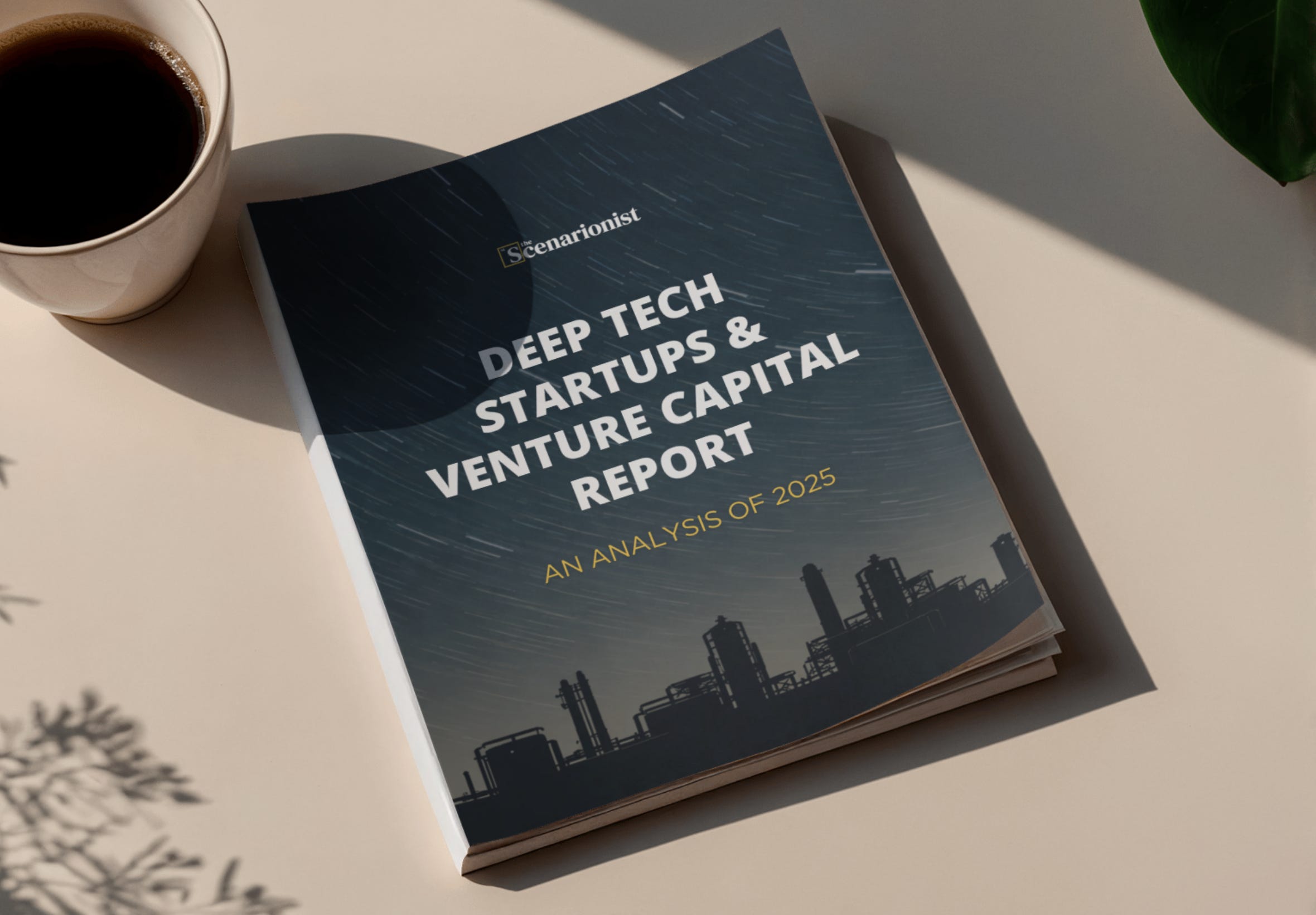
As every January, the year opened with our annual report: Deep Tech Startups & Venture Capital: An Analysis of 2025—a full-cycle study of the year just closed, designed to start 2026 with a clear, disciplined view of what actually changed.
The premise is simple: advanced technology shifts gears when prototypes become systems, pilots become assets, and balance sheets start to carry factories, grids, supply chains, and regulated distribution.
Those shifts are measurable—through round sizes and terms, project scopes, unit capacities, offtake structures, manufacturing footprints, sovereign programs, and the increasingly explicit linkage between compute, energy, and industrial policy.
This annual report exists to make those dynamics visible, so that 2026 begins with a grounded understanding of what really happened in 2025—and so challenges can be tackled with conviction and opportunities pursued with intent.
In January, the first three chapters were published:
Chapter 1 — 2025 in Data: Q1–Q2
The opening ledger of the year: month-by-month numbers across AI infrastructure, energy and grids, critical minerals, space and defense, biology and health—showing when the underlying structure of the year first came into focus.
Chapter 2 — 2025 in Data: Q3–Q4
The second half of the tape: where early signals hardened into contracts and infrastructure logic—fusion PPAs signed before electrons, microreactors shifting into factory-line manufacturing plans, robots priced as opex, GPUs treated as collateral, and interconnect reclassified as defense-grade.
Chapter 3 — Control Points Across the Industrial Stack
The thematic pass that turns the tape into structure: semiconductors, photonics and high-speed interconnect; advanced materials and industrial chemistry; quantum technologies; AI infrastructure and data centers; and energy systems and storage. It traces how limits on bandwidth, power, feedstock, and uptime hardened into financial constraints and then into investable bottlenecks—showing where value really pooled in 2025 and where exits, M&A, and sovereign capital are starting to concentrate.
Stay tuned in February for Chapter 4, which completes the 2025 map across defense and space, synbio, agrifood, health, and biology, and the evolving exit architecture for long-cycle deep tech.
BEYOND THE CONVERSATION — STRATEGIC INSIGHTS FROM THE EPISODE
What Real Differentiation Looks Like (Outside the Lab)
In early-stage life sciences, it’s easy to mistake “strong science” for “real differentiation.”
A technology can be impressive on its own terms and still fail the test that matters most in venture-backed company building: whether it is meaningfully distinct in a way that changes outcomes.
The discipline here starts with a willingness to be uncomfortably honest. Not about whether the research is good, but about whether it is truly different from what the market is already moving toward.
Moreover, certain themes become dominant—first in academic attention, then in investor appetite, then in the number of companies formed around similar approaches.
That pattern creates a predictable risk: when a theme is “hot”, many teams end up working on adjacent problems with variations that are technically elegant, but strategically crowded.
In that environment, “we’re working on X” is rarely enough.
What matters is whether the work changes the core constraints that make the problem hard in the first place.
A practical way to pressure-test differentiation is to ask whether the company is addressing the root issue—not just a visible symptom.
For instance, in areas where there is a lot of activity, like the current proliferation of different CAR-T “flavors,” the field is full of strong teams doing exciting work.
And yet the question remains: are these approaches tackling the central reasons CAR-T is difficult to make work, and difficult to make work financially at scale for a broad patient population?
In conclusion, differentiation is not the ability to describe a new twist on an existing idea. It is the ability to point to the bottleneck everyone is living with and explain, clearly, why this approach changes that equation.
Scanning the landscape: labs, corporates, and startups
The most common failure mode at this stage isn’t a lack of intelligence or effort. It’s insulation.
Scientists often become deeply focused on the trajectory of their own research and miss how quickly adjacent work is evolving around them—sometimes in the lab across the hall, sometimes in a corporate program, sometimes inside a startup that has already translated similar ideas into a development roadmap.
The antidote is not more conviction. It’s more context.
Building an investable company requires actively mapping what else is happening:
Which labs are converging on similar mechanisms?
Which industry groups are quietly pushing related programs?
Which startups are already positioned a step ahead in clinical development?
That kind of scanning is not a distraction from research. It’s part of doing the strategic work required to turn science into a company that can defend its position.
This process is also where founders can discover something valuable: that “uniqueness” often doesn’t live in a single metric. It lives in how a technology fits into the overall competitive landscape.
The moment a founder can say with confidence, “Here’s what others are doing, here’s what that means, and here’s why our approach is fundamentally different,” the story shifts.
The company is no longer relying on the audience to infer differentiation; it is demonstrating it. (And here, of course, communication skills are not optional.)
Why forcing a single research thread into a company can backfire
There is a subtle but important tension in scientific entrepreneurship. Researchers often feel an implicit pressure to commercialize their own work—to take the project they know best and build a company around it.
But real-world scenarios repeatedly surface a different pattern: many successful companies begin not with forcing a specific research thread into a startup, but with stepping back and selecting the best opportunity available, even if it is not the most “emotionally owned” by the founder.
That shift requires humility and curiosity.
It means looking beyond the boundaries of what you personally developed and asking a more strategic question:
“What is the most compelling technical opportunity to build a durable company right now?”
Sometimes the best answer comes from your own lab. Sometimes it comes from noticing another group’s work and recognizing that it may be closer to a true commercial inflection point.
This is not an argument against building from your own research. It’s a warning against treating that path as the default.
When a founder is too attached to a particular project, they can overlook how crowded the space is becoming, how much of the “core issue” remains unresolved, or how much of their pitch relies on incremental improvements that are legible mainly to other specialists.
In the earliest stages, the goal is not to protect a thesis. The goal is to find the sharpest wedge: something that is both scientifically real and strategically distinct enough to justify building a company around it.

Turning Technical Work Into a Venture-Grade Case
A recurring gap for technical founders isn’t tech competence. It’s translation.
Academic training teaches you to let the data speak, to treat the numbers as the argument, and to assume the audience shares the same interpretive framework.
Fundraising and venture building are different.
The audience is broader, the incentives are different, and the job is not to prove you can generate strong results in isolation. The job is to make it unmistakably clear what the work is, why it matters, and why it can become a company.
That’s where storytelling becomes less of a “nice to have” and more of a core operating skill. The point isn’t to oversimplify.
It’s to structure the narrative so that someone who isn’t living inside the science can still follow the causal chain:
What problem is being solved
Who it affects
What changes if the solution works
Why this specific approach has a credible shot at changing outcomes
This need shows up early with investors, but it doesn’t stop there. The same narrative muscles are what eventually help founders recruit talent, engage partners, and build trust with stakeholders who are not evaluating the work the way a peer reviewer would.
Making the market legible
In biotech, founders are often closest to the mechanism, the molecule, or the platform—while investors, collaborators, and future hires need a clear view of the opportunity it unlocks.
The trap is to assume that the market story is self-evident if the science is strong. It usually isn’t.
The market needs to be made legible.
That starts with clearly connecting the technology to a real, meaningful population—often framed as a large unmet need—and explaining why solving it would matter at scale.
The emphasis here is not on building a perfect model in the earliest conversations. It’s on presenting a coherent, understandable picture of the magnitude: the kind of opportunity this could become if the technology delivers.
The way that picture is communicated matters. Scientists can get pulled into details that are persuasive inside a technical community but do not land with a broader audience.
The challenge is to focus on the few points that carry the weight: the size of the unmet need, the reason existing approaches are insufficient, and the reason this approach changes the odds.
Early Economics
In the earliest stages, the point of “running the numbers” is not to build an elegant spreadsheet that pretends the future is knowable. It’s to develop a grounded sense of scale.
When a team is operating with a molecule in a lab, and the company is still forming, precision can easily become theater. What actually helps—both for founders and for investors—is a view on orders of magnitude.
One practical way to get there is to start with industry benchmarks.
If you’re working in an indication or sub-area that isn’t yet intuitive, looking at comparable programs and comparable companies gives you a reality check on what “big” tends to look like in practice.
Revenue numbers from drugs in adjacent indications can help establish whether the opportunity is plausibly venture-sized, even before the details are fully known.
Another anchor that often clarifies things is the cost of care.
For patient populations where there is no therapy or where existing therapies are not optimal, the current spending profile can reveal a lot.
How much is the system already paying annually?
What is the burden on insurers for that cohort?
Even at a rough level, that framing helps establish whether the potential value created by a better solution is large enough to matter. It’s not a pricing model. It’s a sense check that prevents founders from building toward an outcome that can’t support the kind of returns venture capital is designed for.
The underlying idea is simple: at this stage, a sophisticated model doesn’t reduce uncertainty. It often just disguises it. The job is to understand whether the opportunity is likely to be in the right magnitude range, and to be able to explain why.
This isn’t about performing certainty. It’s about demonstrating that you’ve done the work: that you have a view on the market, the commercial mechanics, and how macro changes may affect where the company fits.
Finally, the real value of the exercise is the founder’s internal clarity.
Running these numbers early is a way of validating that the problem is big enough, that the company is oriented toward venture-relevant scale, and that the next milestones being funded actually move the business toward a credible commercial path.
A Case Study from MedTech
In the example discussed during our conversation, the guest described an early-stage MedTech company that did a notably thorough job thinking through the economics very early on.
Rather than relying on a highly detailed forecast, the team anchored its assumptions in real-world reference points: comparable technologies, reimbursement codes and pathways, and a practical breakdown of payer mix (e.g., Medicare vs. private insurance) alongside treatment volume.
They also sanity-checked the model through conversations with clinicians and stakeholders in integrated care systems, and paired that with an “optimistic but realistic” view of market penetration based on where adoption dynamics actually were.
The takeaway was simple: use credible benchmarks and reimbursement reality to establish an order-of-magnitude opportunity, and keep early models grounded in how the system pays and adopts.

Commercialization Risks: Therapeutics vs. MedTech
Commercialization risk shows up very differently depending on what kind of company is being built.
In therapeutics, once there is a drug that addresses a major unmet need, and it can move through the clinical and regulatory pathway successfully, commercialization is often less of a central concern. The path is relatively well understood: generate the right evidence, get approved, and the market tends to have established mechanisms for uptake.
In MedTech, the profile can invert. Regulatory approval can be a major hurdle, ”the first boss”, but commercialization becomes “the final boss”. Getting through regulatory requirements does not automatically translate into adoption. What matters afterward is whether clinicians will actually use the technology, whether it fits into their workflows, and whether insurance will cover it.
Those factors determine whether the product becomes real revenue or stalls after technical success.
This is part of why MedTech can feel harder to underwrite from a venture perspective.
It’s not only that clinical and regulatory risk exist; it’s that there is often an additional layer of uncertainty about whether the market will move once the product is “ready.”
A founder who understands that early and can speak to it directly can materially change how investors perceive the overall risk stack.
De-Risking Go-to-Market
A common commercialization trap in MedTech is the chicken-and-egg problem between clinician adoption and insurance coverage.
Doctors may be hesitant to adopt a new device or technology without coverage, while insurers may hesitate to pay unless there is wide adoption. That dynamic can become a major bottleneck and compound venture risk.
From an investor’s point of view, the equation starts to look like this: clinical and regulatory risk are already high, and then there is an additional risk that even after those are navigated, commercialization may still be difficult.
The way to handle this risk is not to pick a side and hope the other follows. It’s to build awareness early and work on both fronts in parallel.
That means talking to clinicians early—and broadly enough to avoid creating an echo chamber. If a founder only speaks to one group in their immediate environment, it can create a skewed view of how broadly exciting the product really is.
In parallel, it means thinking about what insurers want to see in order to reimburse—whether comparable reimbursement codes exist, or whether a new code might be required.

Early Stage Execution: Team, Milestones, and Capital
Team building: recruiting top talent through vision
The ability to attract talent is evaluated indirectly, but it matters deeply, especially for technical founders who begin as the scientific or technical center of gravity.
Scaling a company requires pulling in people with very different backgrounds—machine learning engineers, biology experts, experienced chemists—and those individuals will not join just because the science is correct.
The common thread is narrative.
Recruiting is similar to fundraising in that it relies on making people believe in what you’re building strongly enough that they are willing to change their own trajectory to participate.
For many, that means leaving well-paid industry roles or walking away from secure academic paths.
To make that leap, they need to understand the vision, the stakes, and why the company is worth betting a meaningful slice of their career on.
This requires being able to communicate with different audiences in different languages—without losing coherence.
The founder needs to hold a broad vision that is legible to varied specialists, and deliver it in a way that generates genuine excitement rather than narrow technical persuasion.
Capital efficiency and milestone velocity
When a company is raising a smaller pre-seed or seed round, the operating constraint is not elegance. It’s speed to meaningful milestones.
If you are not raising tens of millions of dollars up front, resources need to be deployed primarily toward the experiments and execution that unlock the next inflection point.
This has implications for founder compensation and early spending choices.
Founders should expect that, in the earliest stages, they may need to take a pay cut in order to create more room for R&D that accelerates critical progress.
The trade can be rational: if hitting milestones faster enables a stronger Series A or better terms, capital becomes less expensive later, and missed compensation can be recovered over time.
In the same spirit, equity is a powerful tool for early hiring.
Using equity to attract key hires is not only a way to preserve cash; it is also self-selecting. People who value equity tend to be more aligned with mission and long-term commitment.
Collaboration that accelerates vs collaboration that delays
Cost efficiency in the early stages often triggers a natural question:
Should founders leverage university resources or shared infrastructure to reduce burn rate?
There are cases where universities make strategic sense—especially when they have highly specific models, such as unique mouse models, or prototype instruments that aren’t broadly available commercially and that fit the company’s needs extremely well.
But for everyday work, the trade-off can be time.
University equipment may be cheaper, and instruments may be sophisticated, but they are heavily used and will prioritize internal academic work, as they should. That means startups can become second in line, and timelines can stretch.
In early-stage company building, a slower turnaround can be more damaging than a higher cost.
For routine execution, contract research organizations and service companies can be a better lever because turnaround time is often the real bottleneck.
And founders can treat CRO engagement as a process rather than a single vendor decision: run a competitive process, compare multiple providers, negotiate pricing, and use the fact that service companies view startups as future long-term customers.
When vendors believe a company can grow into something meaningful, they are often willing to offer strong terms early, especially if they know you are speaking with multiple alternatives.
The example of cloud providers offering substantial credits illustrates the same logic: discounts today to win durable customers tomorrow. Similar dynamics can apply with CROs and other service partners when founders approach negotiations with that long-term framing.
TechBio Dynamics. Exploring what’s behind the hype

What is TechBio? What's the difference between TechBio vs BioTech? Why now? What's the real value of TechBio Platforms?


