

Resilience is often a material outcome: corrosion resistance, durability, and safety margins.
Dear Builders and Backers,
it’s a pleasure to meet you again at the start of a new year with our monthly deep tech review. The last cycle has been a stress test: higher rates, tighter capital, and sharper demands for measurable impact. Work moved forward where it could be counted—in contracts signed, megawatts reserved, factories commissioned, and supply chains pulled into focus.
January made that shift explicit: AI tied itself to power and cooling, climate work ran through steel, fuels, and storage, and security hinged on production capacity rather than prototypes. As in every month, what follows is the map of what actually moved.
Enjoy the read!
January: The Reality Check
January marked a shift from deep tech as “potential” to deep tech as infrastructure under construction. Capital, governments, and large corporates acted on megawatt-scale commitments, multigigawatt power deals, orbital platforms, and industrial supply chains. The signal across sectors was consistent: what matters now is contracted capacity, manufacturability, and backlog density, not slideware.
Aerospace and Space Systems
SpaceX set the tone for space as an infrastructure business. Secondary transactions implied a valuation of around $800 billion, with internal discussions pointing to an eventual IPO that would rank among the largest ever.
That price tag anchors expectations for launch costs, Starlink capacity, and the economics of every downstream operator that depends on orbital logistics and connectivity.
China’s LandSpace moved in parallel through a different channel: approval to raise 7.5 billion yuan (about $1.1 billion) on Shanghai’s STAR Market to fund its reusable Zhuque-3 launcher under rules tuned for rocket manufacturers.
The deal links sovereign launch ambitions directly to domestic equity markets and treats reusable rockets as a strategic asset class, not a speculative venture.
At the service layer, new contracts turned “space capability” into a product.
Arche Orbital signed with the Maldives Space Research Organization to deliver national space capacity through hosted payloads, data services, and training.
Hydrosat raised European capital to expand a thermal infrared constellation targeting soil moisture and crop stress, while Tomorrow.io’s DeepSky weather network synchronized satellite sensing with AI-native forecasting models.
These moves positioned space data as a standard input into agriculture, water, insurance, and logistics, with reliability and coverage treated as non-negotiable.
Compute and AI Infrastructure
AI infrastructure took another clear step into industrial territory.
Hyperscalers accelerated long-dated power and data-center plans, treating compute capacity as a fixed asset backed by multi-year commitments rather than as a purely variable cloud expense. Meta advanced as a long-term buyer of firm power through agreements with Oklo, Last Energy, and Kairos covering more than 6 GW of dedicated nuclear capacity for data centers, alongside a Natrium framework with TerraPower for up to eight advanced reactors totaling roughly 2.8 GW of firm capacity and the ability to flex above 4 GW via molten-salt storage.
Compute planning and baseload planning effectively became the same exercise.
Thermal and siting variables moved to the center of the stack.
Karman Industries introduced a 10 MW “Heat Processing Unit” designed for zero-water cooling, PUE approaching 1, and mechanical yards up to 80 percent smaller than conventional layouts, defining cooling as a modular industrial asset rather than a facilities afterthought.
On the software and governance side, Depthfirst raised funding as an AI-native security platform, while ChatGPT Health formalized general-purpose models as an interface into regulated healthcare workflows.
Compute emerged as a coupled system spanning silicon, power, thermal design, security, and compliance, where weakness in any layer can stall deployment.
Materials and Advanced Industrial Inputs
Materials and storage activity in January concentrated on companies that can turn chemistry into deployable hardware tied to real supply chains.
The most concrete signals came from batteries, bio-based fibers, and process technologies for critical metals.
In storage, Donut Lab in Finland continued to position its solid-state cells as a drop-in upgrade for demanding platforms. The company reported integration of its packs into Verge Motorcycles’ production electric superbike and is using that program as a bridge toward advanced air mobility and defense aircraft, where weight limits, safety margins, and thermal behavior are specified in detail.
In parallel, MATERIAL in Miami focused on the integration layer rather than new chemistries, advancing its HYBRID3D process for printing full-stack batteries directly into structural components of drones and wearables. Early case studies cited double-digit gains in effective energy density and weight reduction at the vehicle level, which shifts storage from a discrete module to part of the airframe.
On the materials and metals side, Transition Metal Solutions pushed forward with a bioleaching process that uses prebiotics to steer microbial communities in heap-leach operations, aiming to raise copper recovery from low-grade ores and waste streams while cutting reagent and energy use. The company’s approach addresses a central constraint in electrification, since copper demand in transmission, motors, and power electronics continues to rise faster than new mining capacity.
In the realm of fibers and composites, Solena Materials established a pilot line at Imperial College London’s new manufacturing hub to produce tonnes-per-year of AI-designed, plastic-free protein fibers. Near-term applications sit in performance textiles, but the mechanical profile points toward future use in lightweight structural parts and protective gear.
Black Bull Biochar in the UK added another piece to the input stack with its biochar and green-heat plants, which convert biomass into carbon-rich material for agriculture and process heat for industry, effectively turning waste streams into both soil amendments and thermal energy.
Across these examples, the common pattern is materials companies anchoring their roadmaps in manufacturability, local feedstocks, and clear integration points with grid, mobility, and industrial customers.
Industrial Climate and Market Infrastructure
Climate assets stood out when they looked like infrastructure, not campaigns. Green-steel projects that separated physical tons from environmental attributes via certificate structures showed how low-carbon performance can sit inside long-term contracts as a priced line item, rather than as ESG decoration.
Land-based removals and water security followed the same logic. Stack Carbon progressed a Ugandan biochar facility targeting up to 50,000 tons of CO2 removal per year and tens of thousands of tons of biochar for local soils, built on biomass logistics, industrial kilns, and multi-year credit contracts.
Watergen continued to roll out atmospheric water generators producing roughly 1,000–6,000 liters per day from humid air, sold as containerized resilience units across climate-stressed regions.
Two adjacent moves reinforced this “infrastructure over gesture” framing.
RCT Hydrogen advanced an electrolyzer stack plant in Thuringia aimed at 250 MW per year of capacity, positioning itself as local hardware supply for European hydrogen projects. Etlas Biofuels—the joint venture between Corteva and BP—set out plans to source around one million tonnes of oilseed feedstock annually by the mid-2030s for sustainable aviation fuel and renewable diesel.
Across these examples, carbon, water, and fuels were treated as bankable services with feedstock certainty and long-dated offtake, with technology risk managed inside an infrastructure-style stack.
Defense and Dual-Use
Government and defense programs continued to act as one of the structured testing grounds for deep tech. The U.S. Department of Defense’s $1 billion anchor investment in L3Harris’s missile business was structured to expand solid-rocket-motor and missile production while sharing industrial-base risk.
AIM Intelligent Machines added a more surgical example with $4.9 million in Air Force awards for autonomous earthmoving systems for rapid runway and airfield repair, a use case that also maps to civilian infrastructure. In Europe, the SAFE defense loan facility moved into implementation as the Commission approved about €38 billion of national plans across ammunition, missiles, drones, air and missile defense, and infrastructure protection, giving more visibility on where dual-use demand may cluster.
Anduril’s plan for a large Long Beach campus, near ports and aerospace talent, underscored how autonomy companies are pairing software with dedicated manufacturing and integration capacity.
Across portfolios, obligation density—awarded obligations relative to equity raised—remained a useful lens. Companies such as Anduril, Vannevar, and Saronic showed comparatively high levels of contracted obligations against their capital bases, while firms like Chaos, with roughly $1 billion raised but limited awarded work, sat at the opposite end of the spectrum.
At the same time, large contractors and diversified industrials increased their presence on cap tables for autonomy, ISR, and critical-infrastructure platforms, often with an eye to future integration rather than immediate M&A. Procurement mechanics, industrial footprint, and partnership structures are therefore emerging alongside technology as key variables in how defense-oriented startups progress.
Quantum and Frontier Compute
Quantum and adjacent frontier compute aligned more tightly with national strategies. D-Wave agreed to acquire Yale spinout Quantum Circuits for $550 million, adding a superconducting gate-model roadmap to its annealing-based portfolio. In parallel, a separate quantum machine-learning demonstration scaled to 50 qubits on current hardware, offering a tangible benchmark for what near-term systems can support.
Policy and programs tracked that technical progress.
Efforts to reauthorize the U.S. National Quantum Initiative and analogous moves in Europe and Asia positioned quantum hardware, control electronics, cryogenics, and photonics as coordinated capability stacks.
For startups and incumbents, fit with national testbeds, standards efforts, and funding programs became a practical advantage in securing customers and partnerships, not just a signaling device.
Manufacturing and Industrial Execution
Manufacturing sat beneath many of these developments as the decisive constraint. Electrolyzer plants in Germany, solid-state cell lines in Europe and Asia, aerospace-qualified composite facilities, and precision-optics shops all pointed to process control, supplier coordination, and quality assurance as the real gatekeepers between prototype and asset.
Peak Technology’s APEX platform, built as an OEM-to-OEM environment for product lifecycle management, assembly, and integration, positioned manufacturing middleware as a leveraged across fusion hardware, quantum devices, robotics, and high-end aerospace systems.
Capital structures mirrored that industrial tilt. Early-stage rounds in photonics, networking, and thermal systems often cleared at growth-stage valuations, while blended stacks combining venture equity, project finance, and non-dilutive instruments became more visible.
Matching capital duration to asset life started to look like part of the product architecture itself, because it determines how much runway exists to climb steep manufacturing learning curves.
Transportation and Mobility
Transportation and autonomy concentrated where corridors, customers, and safety cases are already explicit. Freight and defense attracted the most credible early attention: Mobileye acquired humanoid-robotics startup Mentee Robotics to expand its autonomy capabilities, truck OEMs continued experimenting with generative-AI tools for long-haul operations, and programs for large unmanned surface vessels advanced under security and logistics mandates.
Scaling remained constrained by platform control and distribution.
Volvo Trucks’ work with Waabi on hub-to-hub freight autonomy sat on top of existing long-haul routes but still depended on OEM integration, shipper relationships, and regulatory comfort to move beyond pilots.
At the same time, Volvo Cars’ decision to pause a planned Swedish battery plant while its trucking arm pushes ahead on autonomy underlined that robotic freight can progress even as electrification timelines are reconsidered—particularly where hybrid drivetrains and drop-in fuels keep existing platforms in play.
In more constrained domains, warehouse and yard-automation systems for trailer spotting and pallet movements advanced where they could be retrofitted across depots without disrupting operations.
Across these efforts, technical performance was necessary but not sufficient: the decisive factors remained the ability to standardize across fleets, secure OEM and operator partnerships, and plug into existing logistics and defense procurement channels. Mobility, in that sense, continued to act as a stress test for autonomy strategies: only stacks that fit cleanly into real corridors and real contracts gained momentum.
Last Month in Data
750 MW — OpenAI’s partnership with Cerebras will add 750 MW of ultra–low-latency compute capacity to its platform in stages through 2028, explicitly framed around user-visible inference latency rather than abstract “training scale.”
10 MW — Karman Industries’ modular Heat Processing Unit is designed as a 10 MW block targeting zero-water cooling, PUE ~1, and up to 80% smaller mechanical yards, showing how “AI factories” are being engineered as full-fledged industrial plants.
6+ GW — Meta has signed agreements with Oklo, Last Energy, and Kairos for more than 6 GW of dedicated nuclear capacity for data centers, with delivery timelines stretching into the 2030s.
2.8 GW (flex >4 GW) — TerraPower–Meta’s Natrium framework covers up to eight plants totaling ~2.8 GW of firm capacity, with molten-salt storage allowing output to flex above 4 GW to match hyperscale load profiles.
7.5B yuan — China’s LandSpace secured approval to list on Shanghai’s STAR Market with a planned raise of 7.5B yuan (≈$1.1B) to accelerate its reusable Zhuque-3 launcher, using capital markets as de facto industrial policy for sovereign space supply chains.
$550M — D-Wave agreed to acquire Yale spinout Quantum Circuits for $550M, while a separate collaboration demonstrated a quantum ML scheme scaling to 50 qubits on current hardware—two concrete “de-theorizing” signals across the quantum stack.
$1 billion — The Pentagon’s $1 billion anchor investment in L3Harris’s missile unit positions the U.S. government as a lead investor in solid rocket motor and missile production capacity, rather than relying purely on cost-plus contracts. The move comes amid concern over munitions stockpiles, industrial concentration, and supply-chain choke points.
$2.2 million pre-seed — Anzen Industries raised $2.2M in pre-seed funding to develop cell-free biomanufacturing systems built around reusable enzyme reactors and enzyme immobilization, supported by AI-driven design. The capital will fund a relocation to the U.S., Anzen’s first manufacturing facility, and expansion of industrial collaborations.
$100 million Series B — Cambium, an advanced materials company, raised a $100M Series B led by 8VC and strategic investors. It uses AI, chemical informatics, and HPC to design and manufacture novel polymers and will use the capital to scale aerospace-grade production across the U.S., U.K., and Europe, including high-performance composites and thermal protection systems for hypersonics.
Policy and Regulation Watch
A focused extract from our wider regulatory observatory—spotlighting the policy moves that quietly set the terms for Deep Tech ventures.
🔸The U.S. explicitly elevated 6G from “telecom roadmap” to national-security doctrine.
A National Security Presidential Memorandum asks agencies to assess and rebalance spectrum bands (including 7.125–7.4 GHz) on a 12-month timeline, while the State Department is tasked with coalition-building ahead of WRC-27. This frames spectrum policy as a central tool for guiding future RF, device, and network investment, and provides more visibility for long-term 6G infrastructure planning.
🔸 India made early-stage deep tech more “non-dilutive compatible.”
By removing the 3-year existence requirement for DSIR recognition, India allows younger companies to access R&D incentives, fiscal benefits, and program-linked support earlier in their lifecycle. For deep tech founders, this can improve the capital efficiency of long development programs without immediately increasing equity dilution.
🔸The EU hardened waste regulation into an investable compliance + infrastructure wedge.
A targeted revision of the Waste Framework Directive and the Packaging and Packaging Waste Regulation (PPWR)—applying directly from August 12, 2026—tightens food-waste reduction targets and broadens producer responsibility, including textiles. These changes increase cost and accountability for producers, and are likely to stimulate demand for data/traceability platforms, product redesign services, and recycling infrastructure(especially in textiles and higher-quality plastics).
🔸U.S. quantum policy is being stabilized on a multi-year cadence.
A bipartisan effort to reauthorize the National Quantum Initiative suggests continued federal engagement across NIST, NSF, DOE, and NASA, with an emphasis on competitiveness and national security. For companies and research partners, this points to a more predictable framework for pilot projects, consortia, workforce programs, and enabling technologies (such as cryogenics, photonics, and control electronics), even as export controls and standards continue to evolve.
🔸The UK centralized cyber defense—and raised the compliance floor for critical services.
A £210M cyber action plan elevates the Government Cyber Unit into a cross-government coordination “nerve center,” alongside a proposed Cyber Security and Resilience Bill that would introduce stronger minimum standards and faster incident reporting. This is likely to raise baseline expectations for resilience across critical services and could increase interest in solutions that support monitoring, incident response automation, compliance reporting, and continuity testing.
🔸 The EU quietly pushed “startup infrastructure” as policy: EU Inc.
The proposed optional “28th regime” would aim to harmonize incorporation processes, investment documentation, a central registry, and stock-option frameworks across member states. In principle, this could reduce cross-border friction around cap tables, hiring, and expansion for startups operating in multiple EU countries, though the practical impact will depend heavily on detailed implementation.
🔸 The U.S. created a clearer pathway for deep-sea mining permits beyond its waters.
NOAA finalized a consolidated process under DSHMRA that allows exploration licenses and recovery permits to be pursued in parallel, potentially shortening overall permitting timelines. While environmental and international-governance questions remain significant, the rule may increase attention on subsea robotics, remote operations, environmental monitoring, and compliance/data tools that support responsible exploration and resource assessment.
Three Breakthroughs
What changed, technically—and why it matters.
1) Fusion moved toward an engineered system via a high-fidelity digital twin
What changed: Commonwealth Fusion Systems developed plans for an AI-enabled digital twin of its SPARC fusion device in collaboration with Siemens and NVIDIA, further aligning fusion development with established industrial software and simulation tools.
Technical core: The digital twin was designed to ingest design revisions, magnet and manufacturing telemetry, and plasma diagnostics on an ongoing basis. This approach allowed optimization work to shift from infrequent physical experiments toward more frequent model-based iteration in a virtual environment.
Why it mattered: The main constraint in fusion progress is increasingly related to engineering throughput—how quickly teams could converge on a buildable machine, qualify components, and manage integration risk. Using a high-fidelity twin helped shorten design cycles, improve understanding of system behavior, and surface potential integration issues earlier.
Market implication: Over time, organizations that built a repeatable manufacturing and iteration methodology, alongside advances in plasma physics, were positioned to develop a distinctive capability. That process know-how could be applied across multiple projects and teams and might become an important basis for collaboration and technology transfer.
2) Supercritical’s electrolyzers became a reference point for step-change hydrogen efficiency
What changed: Shell prepared a pilot hydrogen project using Supercritical’s high-efficiency electrolyzers, indicating an interest in examining technologies that aimed for more substantial performance improvements in addition to incremental gains.
Technical core: The pilot with Supercritical’s electrolyzers was reported to target roughly 42 kWh per kilogram of hydrogen at high pressure, using a membrane-less architecture intended to reduce reliance on scarce materials and simplify parts of the system design.
Why it mattered: For large-scale hydrogen production, energy use per kilogram and overall system cost are central to project feasibility. Validating step-change efficiency in operational settings, rather than only in the lab, could meaningfully influence levelized costs and how projects are evaluated by investors and partners.
Market implication: If performance and reliability data from the pilot proved favorable, this could support the role of next-generation electrolyzer companies such as Supercritical in future procurement decisions. It could also encourage additional activity in related areas, including specialized manufacturing, materials development, and system integration services.
3) Transition Metal Solutions explored prebiotics to increase copper recovery from existing resources
What changed: Transition Metal Solutions investigated the use of prebiotics—customized carbohydrate blends—to influence microbial communities that extract copper from low-grade ores and waste streams, positioning microbiology as a complementary tool for metals production.
Technical core: The company applied prebiotic formulations to enhance bioleaching yields, aiming to recover more copper from existing mines and recycling streams while reducing the use of traditional chemical reagents and energy in hydrometallurgical processes.
Why it mattered: Copper played a central role in electrification, transmission infrastructure, motors, and power electronics, while new large-scale mining projects typically involved long timelines and significant capital. Even modest improvements in recovery rates from current assets could have a noticeable impact on available supply and project economics.
Market implication: Because biological processes are sensitive to local conditions, the approach highlighted the importance of measurement, process control, and reproducibility. If prebiotic-driven bioleaching demonstrated consistent performance at scale, it could function as a process-intensification layer for miners and recyclers and create opportunities for companies focused on industrial microbiome monitoring, control systems, and decision-support software.
Ten Lessons Learned
Supply-chain robustness is becoming a core source of advantage.
Reliable access to critical inputs—whether specialized materials, advanced components, or launch capacity—is now a strategic consideration that can outweigh small differences in technical performance.Modularity is emerging as a preferred way to manage complexity.
Reusable launch systems, modular power units, and standardized plant designs point toward architectures that can be replicated, upgraded, or swapped without redesigning entire systems.Vertical integration is being applied selectively, not by default.
Some companies are choosing to own critical process steps such as manufacturing or integration while partnering elsewhere, seeking a balance between control and flexibility in capital-intensive environments.Specialized tooling and “middleware” are gaining strategic weight.
Software and hardware layers that link design, manufacturing, and operations are becoming businesses in their own right, allowing more participants to plug into complex supply chains.Capital is evaluating governance quality alongside technology quality.
Board composition, reporting practices, and stakeholder management are increasingly important in assessments, especially where projects touch public goods such as energy, spectrum, and critical materials.Regulatory regimes are acting as filters for where capital flows.
Jurisdictions that combine clear environmental rules, security requirements, and predictable permitting are positioning themselves as preferred locations for new plants, data centers, and test sites.Public markets are slowly reopening to complex hardware stories.
Listings in space and industrial technology, along with expectations around larger tech-adjacent IPOs, suggest growing comfort with revenue models tied to physical assets and long-term contracts.Vendor ecosystems matter as much as individual products.
Companies that integrate smoothly into the procurement, service, and software environments of major customers often progress more quickly than technically similar competitors requiring bespoke arrangements.Manufacturing readiness now sits alongside technical readiness.
Battery lines, materials plants, space hardware, and advanced components are being evaluated for tooling, yields, quality systems, and workforce depth—not just for their underlying science.Government programs are increasingly behaving like lead investors.
In missiles, quantum, and space infrastructure, public capital is being structured as anchor commitments that attract private investment, with clearer expectations around delivery, reporting, and underlying unit economics.
Last Month on The Scenarionist
Deep views on Deep Tech to see clearly, decide with discipline, and move first.
INSIGHTS & ANALYSIS
Deep Tech Startups & Venture Capital Annual Report
An Analysis of 2025
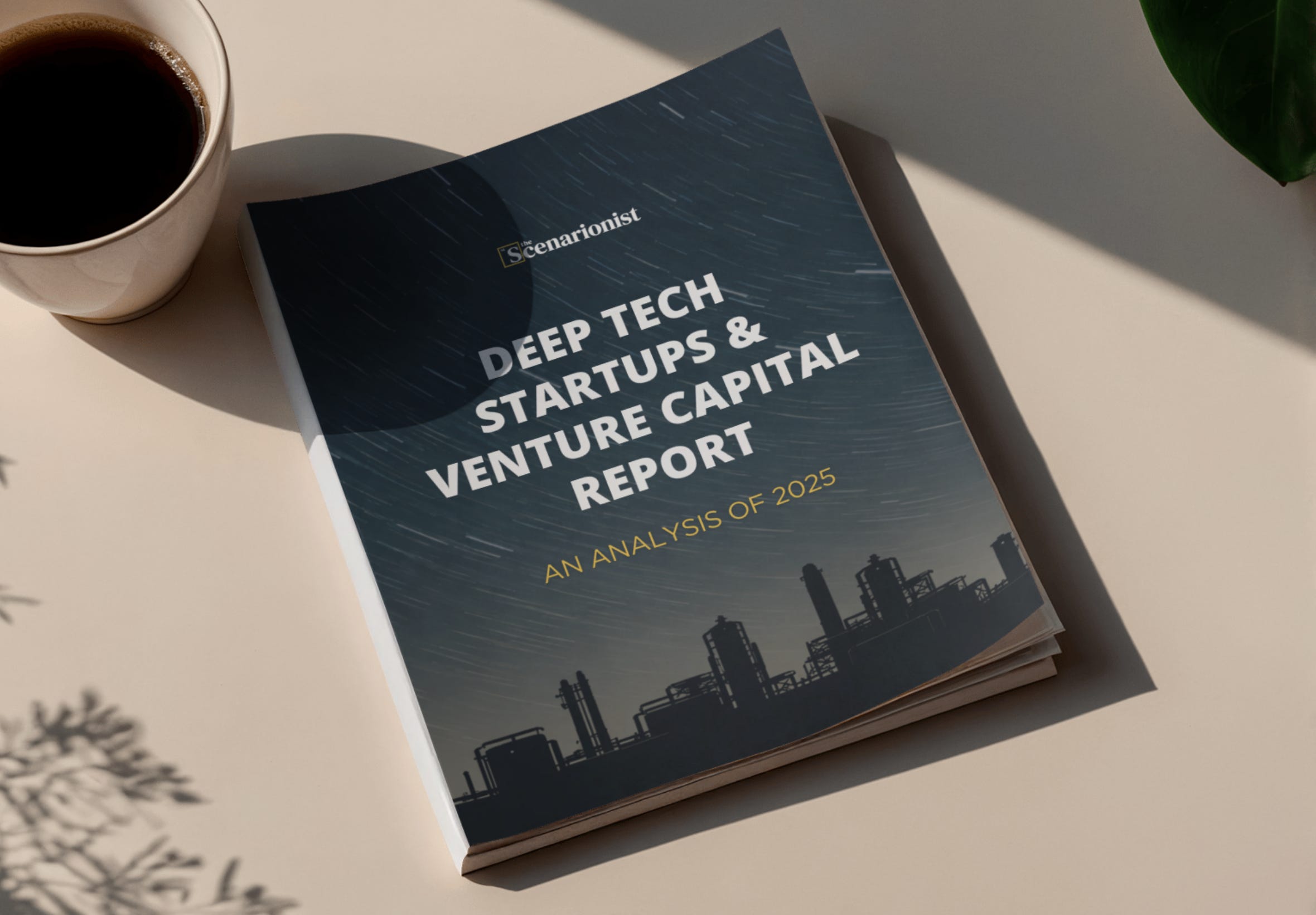
As every January, the year opened with our annual report: Deep Tech Startups & Venture Capital: An Analysis of 2025—a full-cycle study of the year just closed, designed to start 2026 with a clear, disciplined view of what actually changed.
The premise is simple: advanced technology shifts gears when prototypes become systems, pilots become assets, and balance sheets start to carry factories, grids, supply chains, and regulated distribution.
Those shifts are measurable—through round sizes and terms, project scopes, unit capacities, offtake structures, manufacturing footprints, sovereign programs, and the increasingly explicit linkage between compute, energy, and industrial policy.
This annual report exists to make those dynamics visible, so that 2026 begins with a grounded understanding of what really happened in 2025—and so challenges can be tackled with conviction and opportunities pursued with intent.
In January, the first three chapters were published:
Chapter 1 — 2025 in Data: Q1–Q2
The opening ledger of the year: month-by-month numbers across AI infrastructure, energy and grids, critical minerals, space and defense, biology and health—showing when the underlying structure of the year first came into focus.
Chapter 2 — 2025 in Data: Q3–Q4
The second half of the tape: where early signals hardened into contracts and infrastructure logic—fusion PPAs signed before electrons, microreactors shifting into factory-line manufacturing plans, robots priced as opex, GPUs treated as collateral, and interconnect reclassified as defense-grade.
Chapter 3 — Control Points Across the Industrial Stack
The thematic pass that turns the tape into structure: semiconductors, photonics and high-speed interconnect; advanced materials and industrial chemistry; quantum technologies; AI infrastructure and data centers; and energy systems and storage. It traces how limits on bandwidth, power, feedstock, and uptime hardened into financial constraints and then into investable bottlenecks—showing where value really pooled in 2025 and where exits, M&A, and sovereign capital are starting to concentrate.
Stay tuned in February for Chapter 4, which completes the 2025 map across defense and space, synbio, agrifood, health, and biology, and the evolving exit architecture for long-cycle deep tech.
DEEP TECH BRIEFING
What Actually Moved in the Deep Tech World
Weekly briefings for the moments when someone around the table asks, “What really changed this month?” and you need a single coherent narrative.
If you needed one memo to explain why 2026 starts with power + orbit + regulation on the critical path, this is it. This edition treats new-space IPO dynamics, hyperspectral marketplaces, and turnkey sovereign space as the same infrastructure story as nuclear baseload for data centers, “regulated AI” going vertical, and the fusion digital-twin push: control planes + contractability + sovereignty quietly defining who scales.
The operating edition for anyone underwriting AI infrastructure. From 750 MW wafer-scale compute and zero-water thermal plants to nuclear “tranches” scoped for hyperscale loads, this briefing shows the month’s key reality: AI is not a software cycle—it’s a plant-design cycle. It also ties batteries, biochar-glass storage, microbes in mining, ammonia routes, and policy moves into a single stack where constraints become bankable wedges.
The “asset class” and governance edition. Fusion edging toward public-market instruments, orbit behaving more like a regulated utility layer (micro-GEOs, AI-native constellations), and ag/biology becoming IP infrastructure (shared cell banks, systemized ingredients)—all while corporate capital, defense, quantum pilots, EU Inc, and deep-sea mining rules reshape who finances and standardizes the production stack.
DEEP TECH CAPITAL MOVEMENTS
What Capital Believes Before the Narrative Catches Up
A weekly X-ray of where serious money is really going in Deep Tech, and what that implies about how the next cycle will be priced.
The week where the underwriting logic becomes impossible to ignore: late-stage rounds start behaving like infrastructure financings, while capital clusters around (i) AI-era power and interconnect, (ii) defense/sovereignty stacks, and (iii) clinical biology platforms that operate more like industrial systems than research projects. If you need a clean read on how the market prices scale + proof + duration in 2026, start here.
💸 5 unicorns, plus a decacorn; 9-figure defense OS, robotics & next-gen aircraft; big fusion & BCI rounds, plus quantum cameras and lithium refining | Deep Tech Capital Movements #53
The reference issue for a key January pattern: AI isn’t getting funded as a story anymore; it’s getting funded where it owns a control plane—over compute, code, missions, materials. Alongside that, state-backed vehicles, defense growth funds, and infra-style debt show up as the “quiet rewiring” of deep tech into long-lived, financeable assets.
💸 Space and sovereignty pull capital; Photonic & networking AI infra reprice seed; Geothermal, storage, and bio-inputs scale quietly & more | Deep Tech Capital Movements #54
The “macro allocation” edition: January ends with capital forming three blocks—sovereign capabilities (launch, magnets, defense), AI/compute infra (photonics, networking, thermal), and climate–bio–materials—and with the capital stack itself maturing (pre-seed deep tech funds, thematic Series A–C vehicles, blended finance, secondaries, real-asset strategies). The implicit lesson is strategic: coordination between capital layers is now a design problem, and teams who align instrument with asset life buy themselves time-to-scale.
DEEP TECH CATALYST
How to Actually Build and Back Deep Tech Companies
Operator-grade conversations and playbooks for the moments when physics is not the problem anymore, but contracts, capex, and integration are.
A grounded stack map of autonomy where it actually becomes a business: constrained industrial domains first, labor scarcity as the initial “why now,” and the persistent bottleneck being data acquisition economics—even with simulation. The business-model shift that matters: from full-stack autonomy dreams to software-first, OEM-aligned approaches, with retrofit-heavy proof cycles that can demand meaningful capital before scalable distribution opens up.
Deep Tech IPO Roadmap: Investors, Metrics, Roadshow | Deep Tech Catalyst n°105
The “how to not get crushed by public markets” edition. IPOs are reframed as deep capital + signaling, not liquidity; the episode walks through the real thresholds for scale, margin profile, and relevance, and why IPO readiness is a 24-month education campaign. The operational point is blunt: missing guidance early becomes structural, not episodic.
Mining Tech from Lab to Exit: Focus, ROI, and Capital Efficiency | Deep Tech Catalyst n°106
A founder-to-exit playbook from inside the mine: how to go from prototype to acquisition by engineering focus, building a living ROI model, and designing capital efficiency into deployments. The key idea is industrial and unsexy: niche dominance is not branding, it’s a constraint system—what you say “no” to determines whether you can become the default choice globally in a bounded market.
The investor-grade lens on why mining and critical minerals are becoming venture-compatible now—and where the venture-scale value pools actually sit. It breaks down the wedge logic (exploration, refining/processing, productivity tech), the adoption reality of conservative buyers, and why non-dilutive capital can change the math enough to make hardware-heavy pathways financeable. If you invest in the atoms behind electrification and AI, this is the underwriting template.
Final Thoughts
Three themes stand out from January. AI, energy, and space now move as a single system, tied together by the same constraints on power, cooling, and materials. Climate work runs through industry: steel, fuels, storage, and process changes carry most of the real impact. Defense and security are measured on factory cadence and backlog depth, with throughput as the scoreboard.
It’s been a pleasure to share this month’s view with you. Thank you for bringing thoughtful attention to a field that rewards patience, discipline, and a very practical eye on what actually shipped.
— Giulia Spano, PhD & Nicola Marchese, MD
“Vision is the art of seeing what is invisible to others”
— Jonathan Swift