

A strong technical advantage can still produce a weak company.
The real test is whether that advantage sits where customers care, where value can be captured, and where the company can retain enough control to make it durable.
Deep Tech venture design often doesn’t start from an unmet customer need, but from a technology with enabling potential.
A new material. A novel manufacturing process. A scientific discovery. A proprietary algorithm. A new approach to energy conversion, sensing, computation, biology, or industrial production.
Something becomes technically possible that was previously impossible.
This is the source of Deep Tech’s extraordinary potential. It is also the source of its strategic challenge.
A new technology rarely points toward a single specific product, customer, or market. It often enables multiple possibilities.
It may improve performance in one application, lower costs in another, shorten a critical process somewhere else, or make an entirely new outcome possible in a market the founding team had never considered.
That broad spectrum is often presented as an advantage.
The company accumulates use cases, customer conversations, and technically plausible directions. Each one appears to confirm that the opportunity is larger than initially imagined.
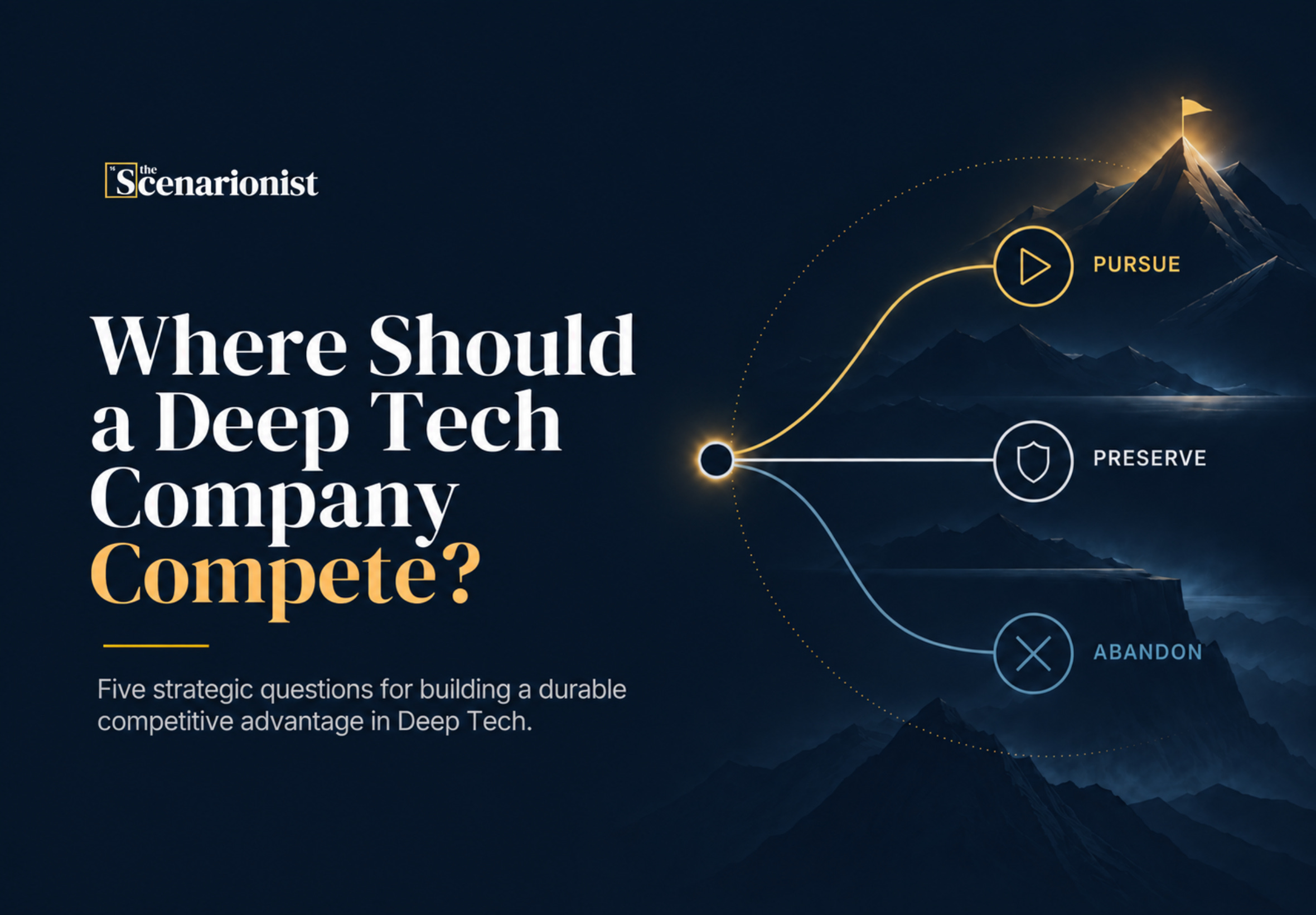
However, a broad optionality creates value only when the company knows what to pursue now, what to preserve for later, and what conditions must be true before the next move becomes rational.
Multiple applications may point to scale and larger markets. They can also fragment attention, accelerate cash burn, and impose significant opportunity costs.
The question is not simply where the technology can be used. It is where it can create an advantage powerful enough to change a customer’s decision and durable enough to support lasting value capture.
The logic of this piece
So, in Deep Tech, the hard question isn’t how many markets a technology can serve, but which one is worth building around.
Deep Tech is industry-specific and product-specific. The dynamics of a semiconductor company are not those of a mining technology, a medical device, or an advanced materials venture.
Still, some strategic questions recur across sectors, particularly during company formation, market entry, and strategic pivots.
This was the starting point that inspired this piece.
The answer does not lie in technology alone. It may depend on the business model, distribution agreements, access to customers, control of critical resources, or the company’s position within the value chain.
Drawing on the experiences and conversations collected over time, as well as the lens developed through direct engagement with people operating in the field, I have organized the piece to provide some curated food for thought.
The objective is to distinguish what deserves commitment now, what is worth preserving for later, and what should be abandoned before it consumes disproportionate capital, time, or organizational focus.
Each section translates that choice into practical questions around market selection, customer commitment, value capture, strategic control, and scaling.
From here onward, only our Premium Members can keep reading.