
By March 2026, the search for new critical mineral supply has become both more urgent and more structurally constrained.
New mines take too long, brownfield economics are worsening, and conventional recycling still struggles once feedstock quality deteriorates.
Which is part of why this cluster of startup activity has become harder to ignore...
The signals started stacking up around November.
But they weren’t showing up in the usual places. Not in miner earnings. Not in policy decks. Not in the standard reshoring rhetoric that now surrounds every critical-minerals conversation.
They were showing up lower down — in fragments, in conversations, in cap tables.
One conversation was about battery black mass in Europe, and why the real bottleneck wasn’t feedstock availability so much as process economics. Another was about copper recovery from ore that operators had long stopped treating as especially interesting. Another was about gallium and scandium showing up in industrial waste streams that nobody, until recently, was really framing as supply.
At first, none of it seemed like the same market.
Then the pattern started to harden.
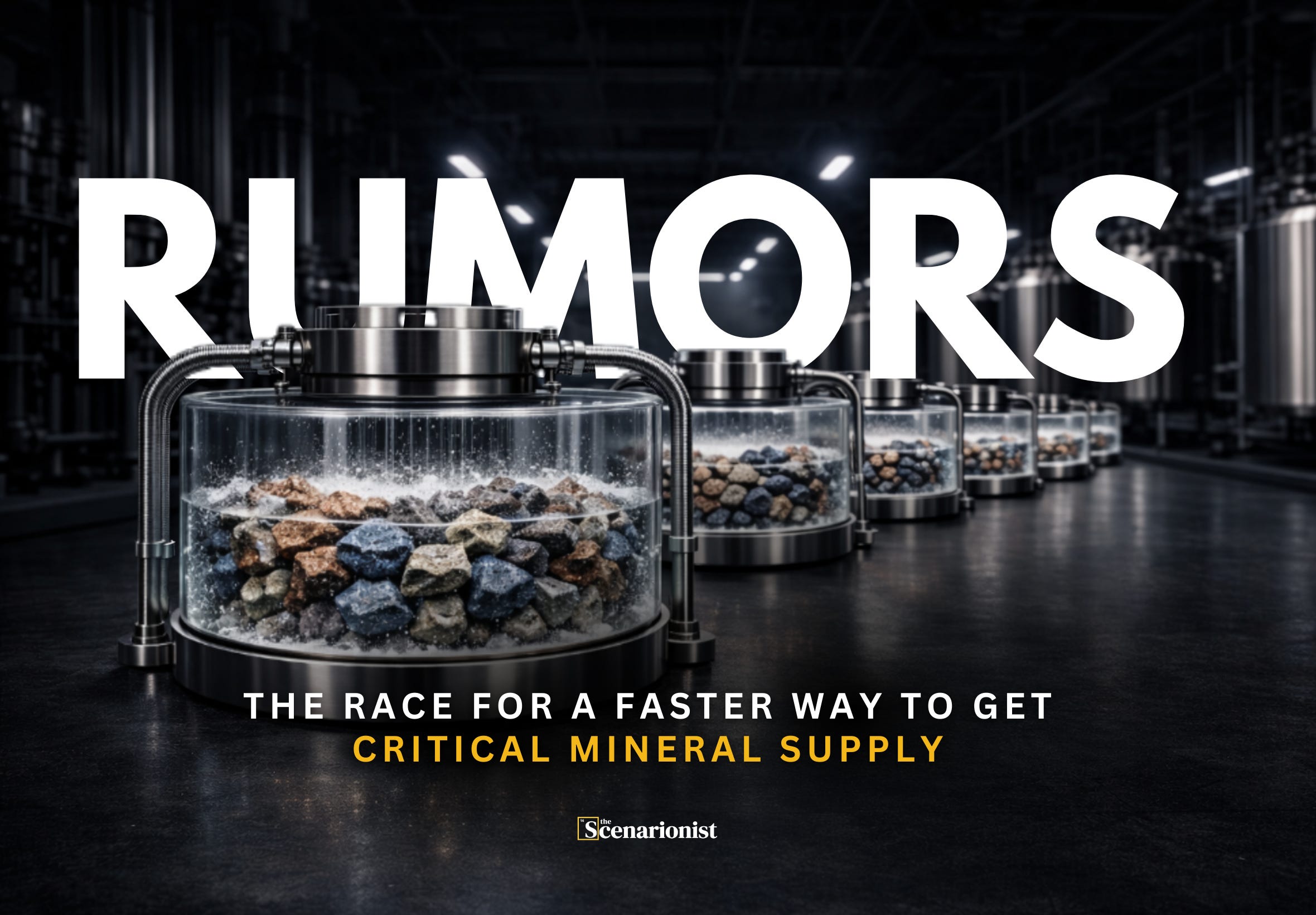
Between late 2025 and early 2026, four seed-stage companies raised around four very different technical approaches to the same underlying problem: how do you create new critical mineral supply from feedstocks the incumbent system already discards?
A Danish startup using molten salt chemistry to crack open dead EV batteries and wind turbine magnets. Two competing approaches to recovering copper from low-grade ore and waste rock that conventional mining struggles to process economically. And a UT Austin spinout building cartridge-like separation modules to pull gallium and scandium from industrial sludge.
Four companies. Four different chemistries. One shared directional bet: the fastest path to new critical mineral supply may not run through a greenfield mine at all.
It may run through waste.
Not recycling in the loose, comforting sense of the word. Not shredding, smelting, and hoping the economics hold. Not substitution. And definitely not a 16-year permitting cycle to blast a new hole in the ground.
What’s emerging instead looks more like a recovery-first supply stack: modular, process-engineered systems designed to extract bankable volumes of strategic metals from feedstocks that already exist at scale — spent batteries, depleted ore, tailings ponds, refinery residues, and other material the legacy supply chain still tends to treat as nuisance, scrap, or write-off.
That is what this edition of Rumors is about.
Not just four startups, but the possibility that they are early expressions of the same market formation: a new race to build a faster path to critical mineral supply by turning discarded material into usable output.
Rumors is The Scenarionist’s column for pattern recognition across emerging trends and market formations in deep tech.
It exists because we spend hundreds of hours mapping capital flows round by round, tracking inflection points, and staying close to the builders, backers, operators, and experts shaping these markets in real time. Most signals look marginal when you catch them one at a time. The interesting part is when they begin to cluster.
This is the seventh edition of Rumors.
If you join The Scenarionist Premium, you’ll get access to every previous edition of Rumors, along with the rest of our Premium Library!
You can find previous editions here:


And now, let’s begin.
Enjoy the read!