

While the AI industry races to build more powerful chips, another competition is unfolding inside the infrastructure that powers and cools them. Its contenders are advanced-material suppliers, and the commercial stakes extend well beyond the semiconductor itself.
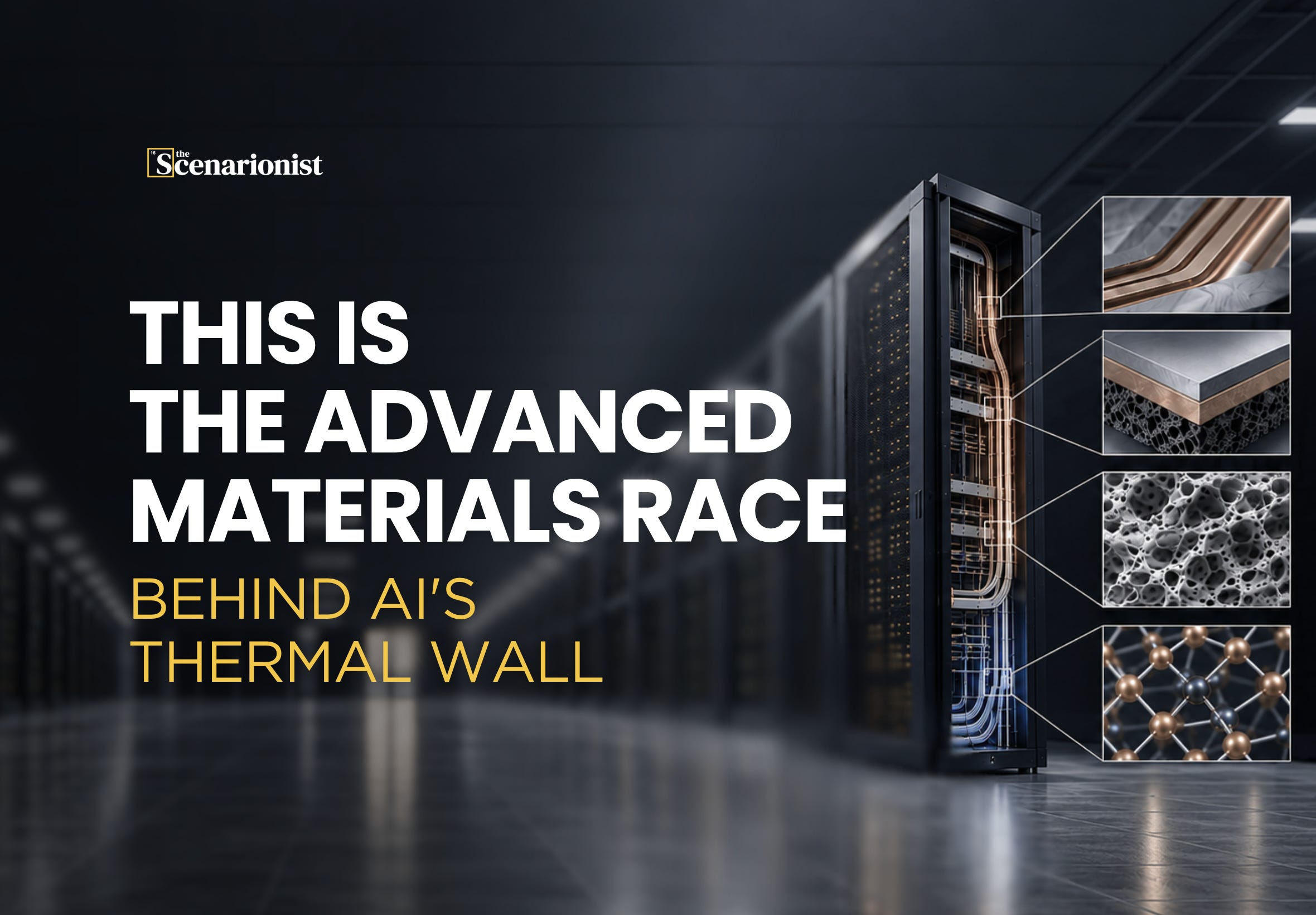
An AI accelerator can contain some of the world’s most advanced semiconductor technology and still have its performance constrained by a material layer only a few micrometers thick. As computing systems become more powerful, the ability to deliver electricity efficiently and remove heat is creating new opportunities in advanced materials, often in parts of the infrastructure that receive far less attention than the chips themselves.
But how are these emerging materials markets taking shape, and which companies are positioned to capture their value?
GaN and SiC are finding applications in emerging power architectures, while synthetic diamond and advanced thermal interfaces offer different ways to manage the heat generated inside increasingly demanding semiconductor packages. The technologies are promising, although their commercial prospects cannot be judged by material performance alone. Manufacturing reliability, integration costs, customer qualification, and purchasing relationships will ultimately determine whether these improvements translate into recurring business.
There are already tangible signs of progress. Infineon and NVIDIA have identified roles for GaN in 800 VDC architectures. NovoLINC has demonstrated high-heat-flux performance using a nanostructured thermal interface, while MiTAC has announced servers incorporating Akash Systems’ diamond-based cooling. Yet these developments represent different stages of industrial progress: an intended architecture, a controlled experiment, and an announced product integration. [1] [2] [3]
The opportunities are becoming more visible, but an important question remains: where will the economic value ultimately accumulate, and which technologies can establish a lasting position in AI’s supply chains?
This analysis examines the emerging markets behind AI’s thermal constraints, the companies pursuing them, and the technical and commercial evidence supporting their progress. It also explores the manufacturing barriers, qualification requirements, and purchasing economics that determine whether a promising material can become a dependable industrial business.
The full analysis is reserved for The Scenarionist Premium members. Membership provides access to independent, exclusive market intelligence and The Scenarionist’s flagship weekly Deep Tech Briefing. From advanced materials to mining and industrial technologies, The Scenarionist examines the markets and companies that could become the architects of the next industrial era.
IN THIS ANALYSIS
AI’s thermal wall is a constraint on usable compute
From infrastructure spending to addressable materials markets
Power delivery: the materials opportunity in every conversion stage
Thermal interfaces and synthetic diamond: where the package loses its advantage
Cooling nearer the silicon: when advanced packaging changes the market
Liquid cooling: materials chemistry, standards and the service economy
The manufacturing and qualification economics behind material adoption
Five Startups Building the Next Generation of AI Thermal Materials
How an advanced material becomes supplier revenue
Three scenarios for how the market could develop