

When liquidity tightens, markets rediscover the difference between optionality and infrastructure. Advanced materials often sit on the right side of that divide.
For years, public and private markets rewarded businesses that looked weightless: software, networks, brands, optionality. But in periods of stress, capital tends to migrate back toward what can be inspected, financed, and relied upon. That shift creates an underappreciated advantage for advanced materials companies.
They are rarely glamorous. But they are often embedded in the systems that still need to function when risk appetite collapses: defense, semiconductors, energy, aerospace, industrial production. Their resilience comes not from narrative momentum, but from qualification cycles, contractual demand, physical bottlenecks, and strategic necessity.
This essay is built as a practical framework for understanding that resilience. It explains why advanced materials businesses can behave differently in risk-off markets, where the downside is actually protected, and where the thesis breaks. Across historical drawdowns, capital-flow data, and operator-level case studies, the goal is not to romanticize hard tech, but to help investors distinguish durable materials platforms from merely capital-intensive science projects.
What this analysis delivers
A framework for why inverse-beta behavior can appear in advanced materials — through collateral, contracts, qualification moats, and supply-chain criticality.
Historical stress tests across major drawdowns — to show when materials outperformed, when they merely held up better, and why.
A capital-flows lens on risk-off markets — including how VC and private equity reweighted toward hard assets, industrial infrastructure, and strategic supply chains.
A practical diligence map — covering the signals that matter most in materials businesses: capex execution, working-capital physics, energy sensitivity, customer concentration, and export-control exposure.
Operator-level case studies across batteries, metals, and magnets — showing how resilience is built, financed, and sometimes overstated.
A downloadable Downturn Screening Pack — to help investors, founders, and operators evaluate advanced-materials businesses under tighter market conditions.
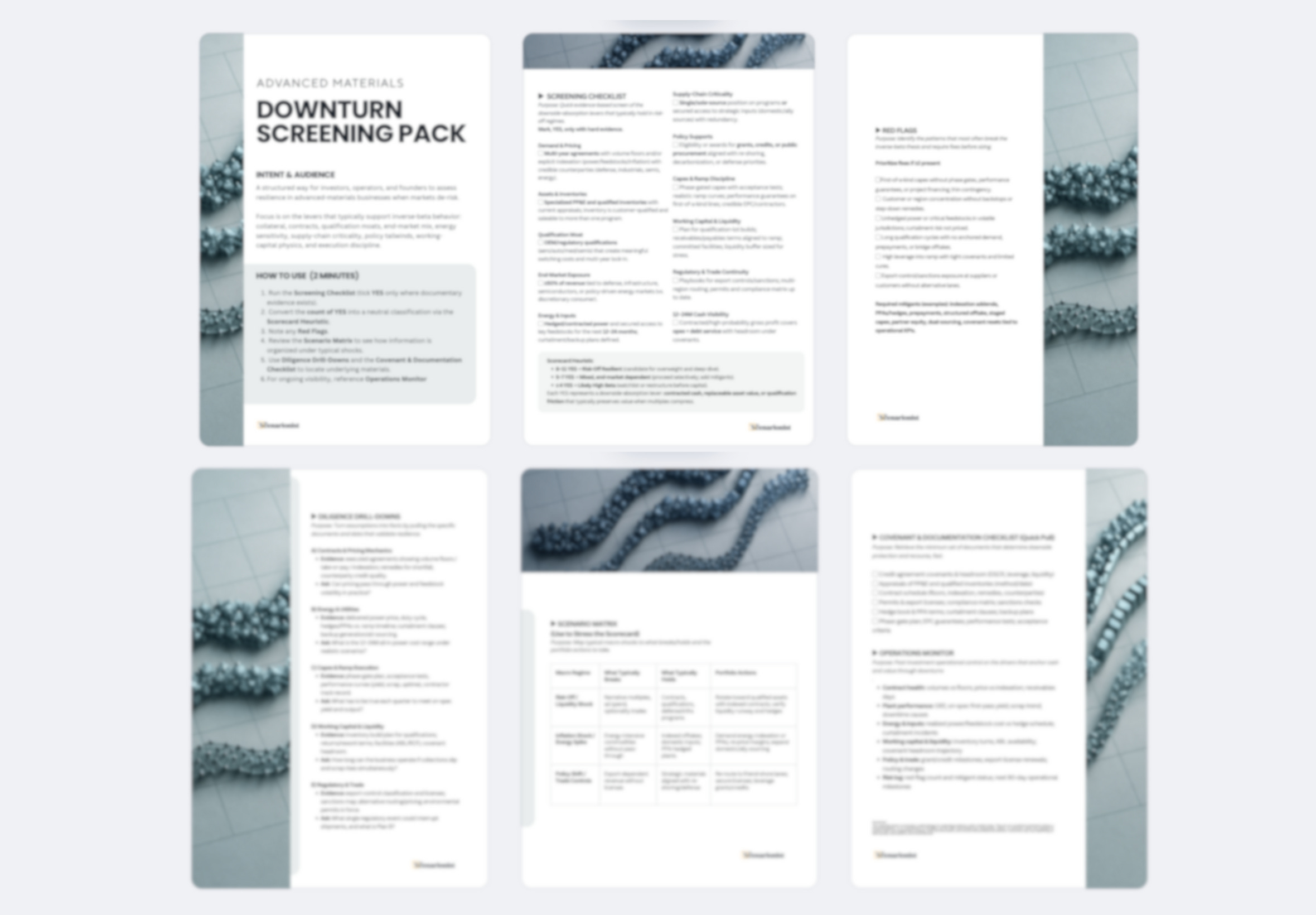
Table of Contents
Introduction: The Paradox of ‘Boring’ Infrastructure and Exciting Markets
“Flight to fundamentals”: why investors seek tangible assets in downturns
Empirical Evidence: Why Assets ‘Fly’ in Fearful Markets
The Venture Capital Flight to Physical Assets
Historical Precedent vs. Contemporary Examples
The Financial Anatomy of Materials Startups During Downturns
The Economics of Materials Startup Resilience
Case Studies
Risks to the “inverse-beta” thesis
Conclusion
Downloadable Toolkit: Advanced Materials — Downturn Screening Pack
1. Introduction: The Paradox of ‘Boring’ Infrastructure and Exciting Markets
Financial history is dominated by intangibles.
In the second half of the 20th century investors glorified software companies whose marginal costs approached zero and whose balance sheets were increasingly dominated by intangible assets. By 2023, intangibles made up over 90% of total S&P 500 assets—a dramatic shift from 1975 when they represented just 17 %.
Many modern firms appear asset‐light because accounting rules do not allow internally generated intellectual property, brands or networks to be capitalized. The result is that markets have come to value growth, network effects and optionality over tangible assets. When valuations depend more on narratives than on replacement cost, investor sentiment swings between exuberance and despair.
However, outside of the limelight of venture‐backed software, a quiet materials revolution is reshaping the physical foundations of the global economy.
Advanced materials such as high‑strength composites, semiconductor substrates, specialty alloys, nanomaterials and novel polymers underpin everything from aircraft and electric vehicles to data centers and quantum chips.
They are the “invisible infrastructure” of modern life; we only notice them when they fail. As infrastructure expert Deb Chachra notes, most people flip a light switch or order a package without ever thinking about the vast network of physical systems behind those simple acts. We expect infrastructure to be boring because that means it is working.
Advanced materials play a similar role: they make our buildings resilient, our airplanes light, our batteries safe and our electronics powerful. Their importance becomes obvious only when supply chains break down or when geopolitical crises reveal critical mineral shortages.
In downturns, when investors flee risky equities and intangible‑rich companies, advanced materials companies often display an inverse correlation with broader market cycles.
2. “Flight to fundamentals”: why investors seek tangible assets in downturns
The refuge of the real
During financial crises investors exhibit a flight to quality, shifting from risky assets (particularly equities) into safer assets such as Treasuries, high‑grade corporate bonds or cash. Investopedia explains that the flight to quality is a “herd‐like movement” triggered by uncertainty; investors may even move into gold despite debates over gold’s industrial usefulness.
Behavioural finance research shows that when fear is high and future cash flows appear uncertain, investors prefer assets with tangible value and stable income streams. This preference extends beyond bonds into commodities, infrastructure and real estate—the so‑called “real asset” classes.
Advanced materials benefit from this psychology because their intrinsic value is tied to physical supply and demand rather than speculative growth.
Materials companies often operate long‑term supply contracts with defence contractors, energy producers or industrial conglomerates. These contracts provide predictable cash flows even when the broader economy contracts. Industry research indicates that defense-sector earnings have low correlation with GDP growth because military procurement depends on geopolitical threats, not consumer sentiment.
During recessions, defence spending often remains stable or even increases as governments prioritize national security. The same is increasingly true for critical minerals and materials used in the energy adaptation; their demand is driven by policy mandates and technological roadmaps rather than consumer whim.
The intangible economy and its fragility
The rise of intangible assets—software, brand equity and data networks—explains much of the volatility in modern market valuations. Nicolas Crouzet and Janice C. Eberly, in a working paper summarized by the UCLA Anderson Review, document that intangible assets now dominate corporate balance sheets.
Sparkline Capital notes that intangible investment surpassed tangible investment around 2000 and constitutes about 40 % of the capital stock. Yet because accounting rules do not capitalize internally generated intangibles, companies heavy on SaaS or brand building, or just aligned with a market sentiment/trend, often appear asset‑light, leading to mispricing.
During bull markets these companies enjoy high valuations because investors project strong growth and network effects. But in downturns, when cash flows become uncertain, the lack of tangible collateral and the difficulty of liquidating intangible assets cause investors to punish them disproportionately.
The intangible economy therefore amplifies market cyclicality.
By contrast, advanced materials companies hold tangible assets—mines, processing plants, reactors, foundries and lab equipment.
They invest heavily in property, plant and equipment, and their valuations anchor on replacement cost, proven reserves and long‑term contracts. When liquidity dries up and intangible valuation metrics (e.g., price‑to‑sales or user growth) collapse, investors often seek companies with hard assets and essential products.
This flight to fundamentals is more pronounced when supply chains are disrupted, as the pandemic illustrated. Meanwhile, intangible‑heavy tech companies may be forced to cut spending on innovation and marketing because their intangible assets cannot be pledged as collateral. The capital intensity and physicality of materials companies thus become protective features in bear markets.