

Welcome back to Deep Tech Capital Movements.
Each week, we monitor Deep Tech capital flows across the globe – startup rounds by geography, sector, and technology, plus new and closing funds – and turn that flow into a reference point for dealflow, benchmarking, and strategic focus.

Greetings!
In this edition, 59 deep tech capital events have been monitored: 53 new company financings and 6 fresh funds and investment vehicles aimed at deep tech. The tape runs from sub-$1 million crowdfunding for seaweed-based films to a $520 million extension round for humanoid robots, with a thick middle of eight- and nine-figure checks in fusion lasers, reusable launch, commercial stations, SAR constellations, vaccines and photonic compute.
To put those numbers into context and to support clear reading of this week’s capital formation, we turned the rounds into three charts that map how capital really moved.
First chart: the global money map.
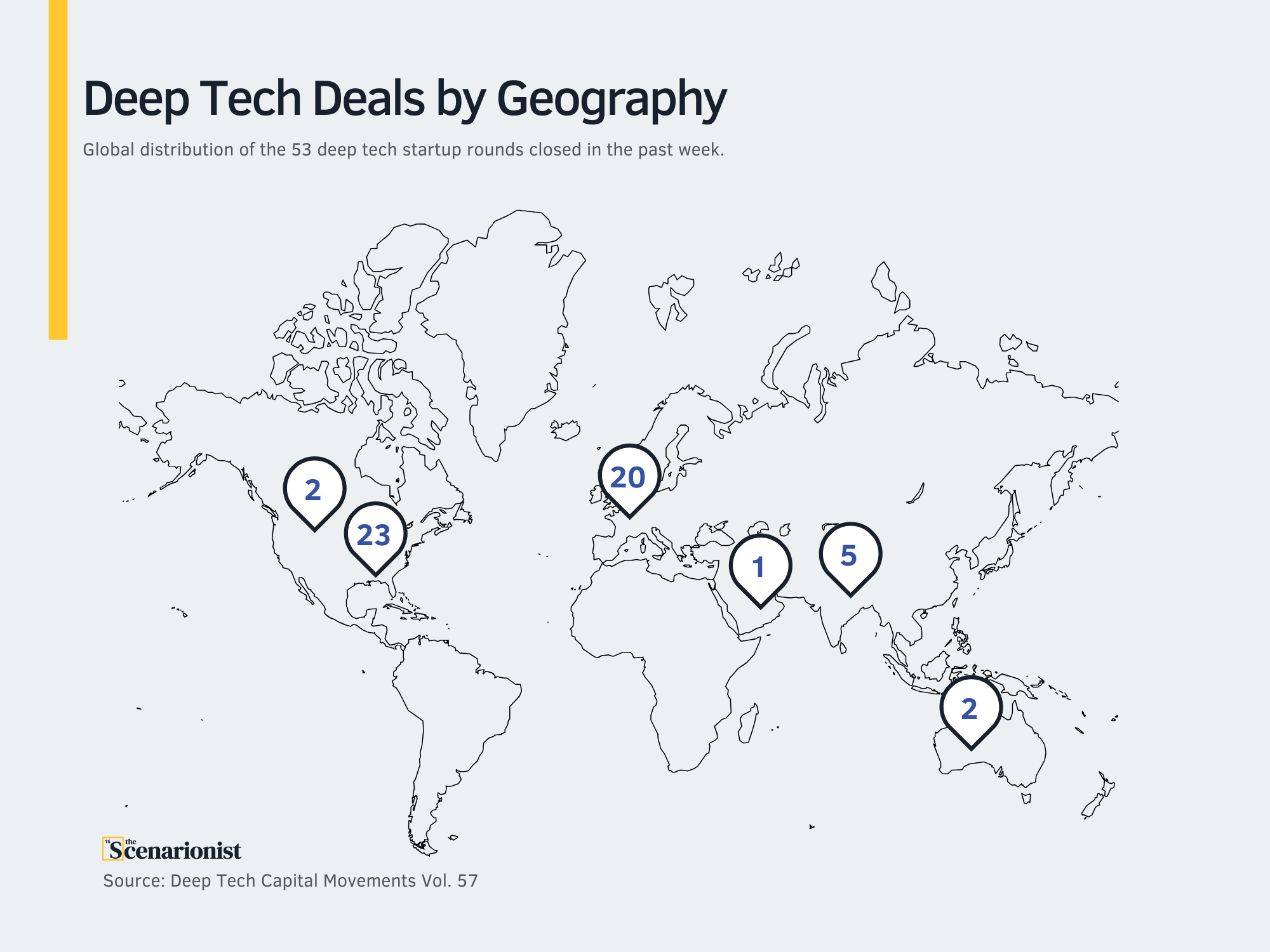
The map clusters major rounds in the United States around humanoid robots, fusion equipment, reusable launch and commercial space programs, with Europe forming a dense band of smaller checks in materials, biopolymers and bio. Canada, Asia, Oceania and the Middle East add focused streams of capital into grids, semiconductors, ag robotics, medtech and defense, giving the week a clearly defined geographic contour.
Second chart: the industry stack.
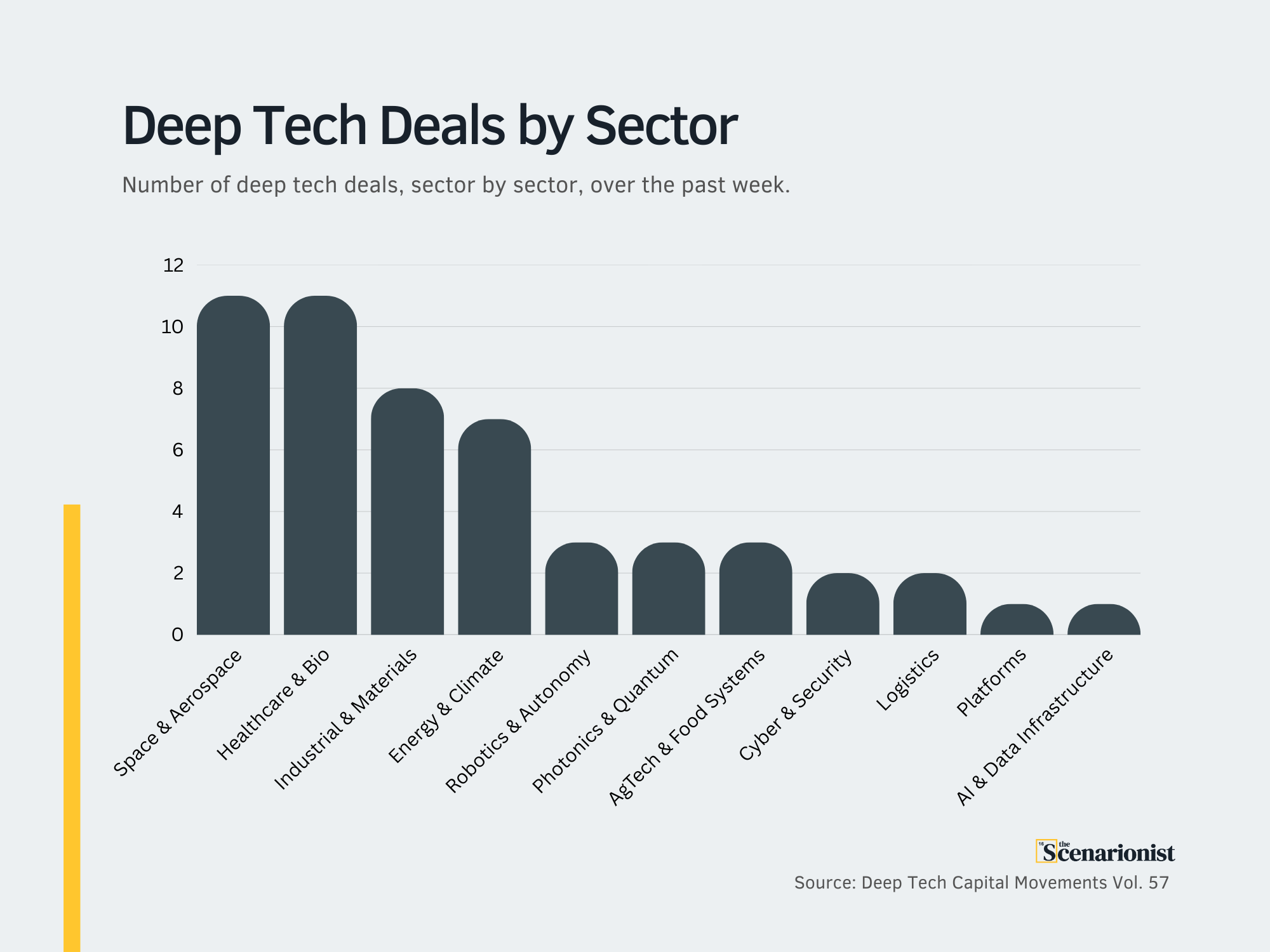
Rearranging the rounds by sector places Space & Aerospace and Healthcare & Bio at the top in terms of capital, with reusable launch, commercial stations, SAR and weather constellations, eVTOL manufacturing, vaccines and computational drug discovery taking substantial portions of the week’s dollars. Industrial & Materials and Energy & Climate form the next tier with ionic-liquid plants, conformal battery manufacturing, composite 3D printing, biopolymers, gasification plants, nuclear uprates and geothermal drilling.
Robotics & Autonomy, Photonics & Quantum, and AgTech & Food Systems line up behind these leaders with concentrated seeds and early Series A rounds in physical AI platforms, nanomaterial integration, pollination drones and autonomous tractors. Cyber & Security, Logistics, Platforms and AI & Data Infrastructure appear as narrower bands that focus on AI-native security, secure collaboration, private cloud racks and vertical software.
This stacked view shows where capital presses hardest on the industrial structure of deep tech.
Third chart: the five largest checks.
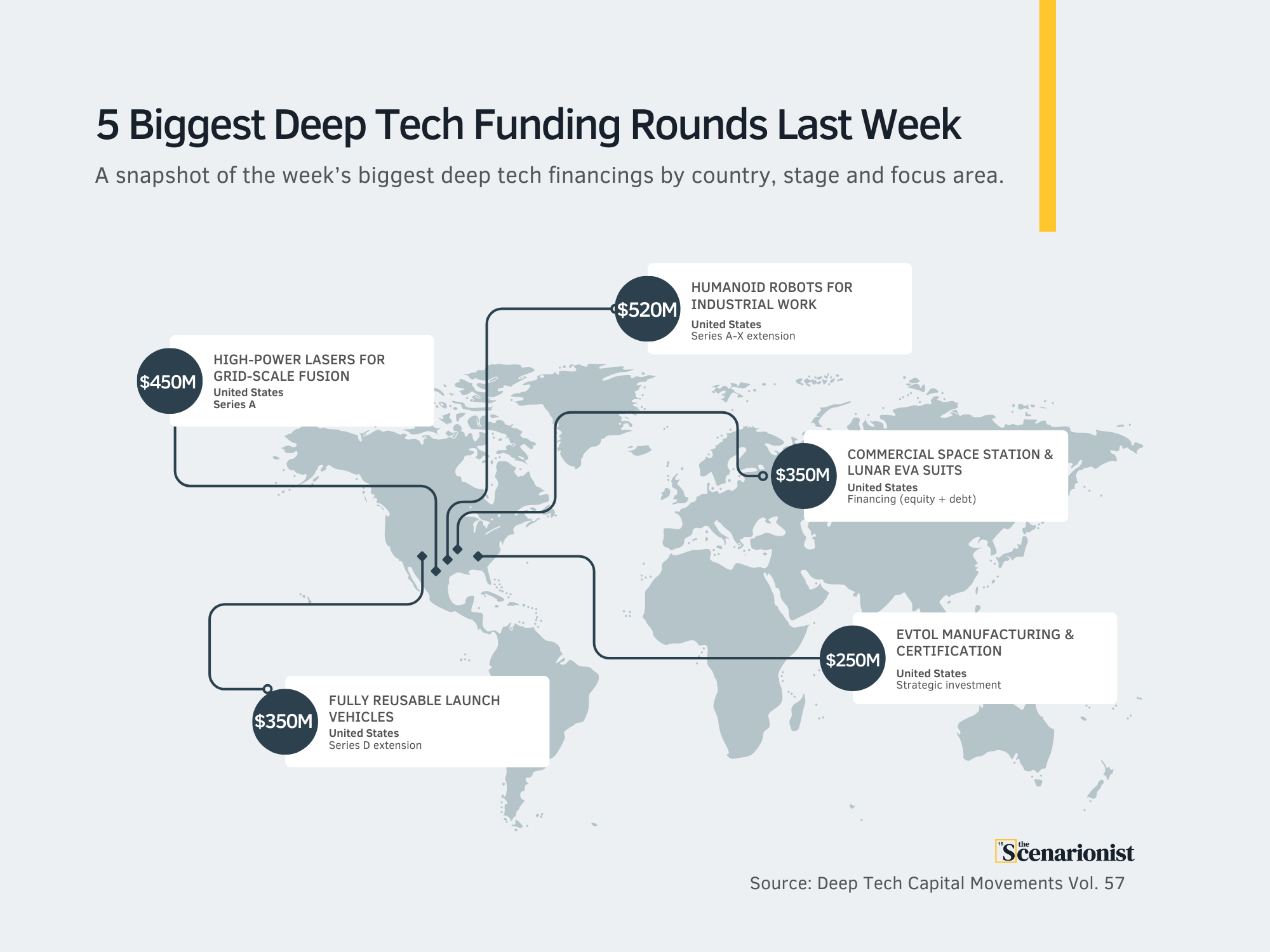
These five entries define the upper tier of deep tech capital for the week. Beneath them sits a thick field of early and mid-stage financings and new funds across materials, energy, bio, industrial software and AI infrastructure, where the execution risk is highest and the next generation of flagship rounds will be decided.
The sections that follow present the full tracking of this week’s activity together with a detailed analysis of the companies, technologies and dynamics behind these numbers.
WEEK 7, 2026
Capital Crowds the Physical Stack: Robots, Rockets, Reactors and Real-World AI
This week’s flow of deep tech capital sketches a clear picture of where the frontier economy is being built.
Checks range from a $520 million extension round for humanoid robots in the United States to a sub–$1 million crowdfunding raise for seaweed-based packaging films in Wales and a €350K pre-seed plus €580K in non-dilutive contracts and grants (€930K total) for radioisotope power systems in Latvia.
The numbers span three orders of magnitude and point in the same direction: investors are underwriting fixed assets that will sit on balance sheets for years and throw off operating leverage, not quick-turn software experiments.
Money is assembling a new physical stack. At the top end, capital goes into humanoid robots intended to stand next to industrial machinery, into high-power lasers that serve as core equipment for grid-scale fusion concepts, into reusable rockets that make launch an infrastructure service, and into commercial stations, EVA suits and eVTOL production lines that extend industrial activity into orbit and low-altitude airspace.
These are not add-ons to the existing economy; they are attempts to revise what factories, power plants and flight operations look like.
Lower down the cap table, smaller but precise rounds stand up ionic-liquid plants for metal-oxide regeneration, conformal battery manufacturing for drones, biopolymer and seaweed-film capacity for packaging, autonomous tractors and pollination drones for horticulture, and physics-based digital twins for stressed power grids.
Each deal ties advanced engineering to a concrete constraint: labor shortages, grid congestion from AI loads, critical-mineral scarcity, defense logistics, packaging regulation or deep-space power budgets.
On the energy side, the Energy & Climate data this week show a deliberate split between frontier physics and near-term yield on existing assets.
On the frontier, Inertia Enterprises’ $450M Series A defines one path to