
Dear friends,
Last week marked two milestones for Deep Tech Catalyst: its 130th episode, and exactly one thousand days since I released the very first one.
1,000 days in which I have consistently worked toward one specific vision: building the playbook I wish I’d had when I started my journey into Deep Tech.
I thought this could be the right time to share a few reflections with you on its origins, where it stands today and where it is going next.
One of the strongest motivations that pushed me to start came from a feeling of disorientation I had back then and still remember very clearly today.
I was coming from the scientific world and stepping into the intersection of technology, entrepreneurship, and capital for the first time, with a technical background and zero experience in business or finance.
I remember sharing that feeling with many of my scientist friends who, like me, had an entrepreneurial mindset, whenever the conversation moved from applied science to topics such as fundraising, ROI, margins, or distribution.
It was clear that venture capital needed compelling, investable plans before being deployed.
But what kind of plan makes sense when it takes five to seven years to reach the market? What roadmap could justify a budget for the first 36 months? And later on? And then, how do you answer the question, “Can this be scaled up?” if the prototype is literally still on paper?
That wasn’t clear at all. At least for me.
After all, who had ever heard of those questions? Weren’t years spent learning chemistry, physics, or physiology enough?
I was starting to fear they were not…
At the same time, everyone around me kept repeating: “Build, measure, learn.” Basically, build as if it were software. However, hardware seemed to be a bit different. It seemed to follow different rules, different timelines, different models.
As a result, I failed many times.
However, not being able to understand where the gaps were in bringing a diagnostic device, an advanced material, or even a quantum technology to market (and, consequently, into the real world) was simply unacceptable.
Bridging that gap was so important then, and it still is today, because I firmly believe that the ultimate goal of science is serving the people by helping them solve their most critical problems.
What could be more important than that?
One day, after weeks of sharing ideas with investors, entrepreneurs, and industry experts, I realized three things:
The SaaS model didn’t fit deep tech.
There was no real way to efficiently build VC-backable Deep Tech companies.
There was a clear need to decode this path and, if possible, build a common language capable of making the exchange of ideas and value more fluid.
It became clear that bridging the gap between science and capital was not only important but necessary for many reasons.
Necessary to make the world a better place. And I don’t mean that figuratively. I mean helping secure energy, water, food, medicine, materials, and everything that allows humankind to build a civilized society.
Moreover, it was necessary for me, because I wanted to find a way to see science and technology flow more effectively from the laboratory bench into the real world. And that was incredibly fascinating.
So, basically, I decided to start by building the playbook I wish I’d had when I started.
A reference point that would have allowed builders around the world to find it a little less damn difficult to understand how to build an investable business plan.
In late 2023, despite some talented pioneers having already defined its concepts and macro-dynamics, the term Deep Tech often sounded like something absolutely mysterious, capital-intensive, and inexplicably difficult to reconcile with a plausible return on investment.
So, in a world dominated by software, engaging with the intersection of hardware and capital would have been rather new territory.
As I always say, in Deep Tech, success is a complex scenario at the intersection of various multidisciplinary factors, such as technologies, talent, capital, B2B industry demand, procurement, go-to-market strategy, and policy.
If The Scenarionist was born to provide an independent map of evolving scenarios and their dynamics, Deep Tech Catalyst was meant to catalyze action among builders and backers through a common narrative, helping them identify opportunities, reach those scenarios successfully, and ultimately tackle some of the greatest challenges facing the world and humankind.
So where to start? With three simple steps.
Start from the financial pull.
Produce it independently.
Keep it constantly evolving.
I assumed that every investor reviews between 150 and 200 pitch decks per year. So, by interviewing investors, I could provide a broad perspective on what makes a Deep Tech company attractive to investors and scalable.
Moreover, the show would also include exited founders and industry experts who had participated in successful projects to provide another perspective that obviously could not be missing: the B2B commercial perspective.
So, I decided to explore the “investability interface” between science and capital in the way I considered as efficient as possible, as fast as possible, and also as broad as possible in terms of background, geography, industry, and company maturity/investment focus.
In one question:
“How is it possible to turn a lab discovery into an investable and scalable company?”
Or even:
“What does an investable and scalable deep tech company look like from a VC perspective?”
That is where I started.
The result was surprisingly interesting, but it required an enormous amount of work and, above all, overcoming some significant barriers.
First of all, I had never done a podcast before.
Second, the only times I had ever spoken into a microphone were small presentations in scientific settings (and a few birthday parties).
Third, there were a significant number of linguistic and terminology barriers to overcome.
Moreover, this project required fairly intense multidisciplinary study of the subject to design top-notch episode themes and, of course, epic T-shirts and hoodies.
However, it had to be done, so I did it. And the result was an incredible experience.
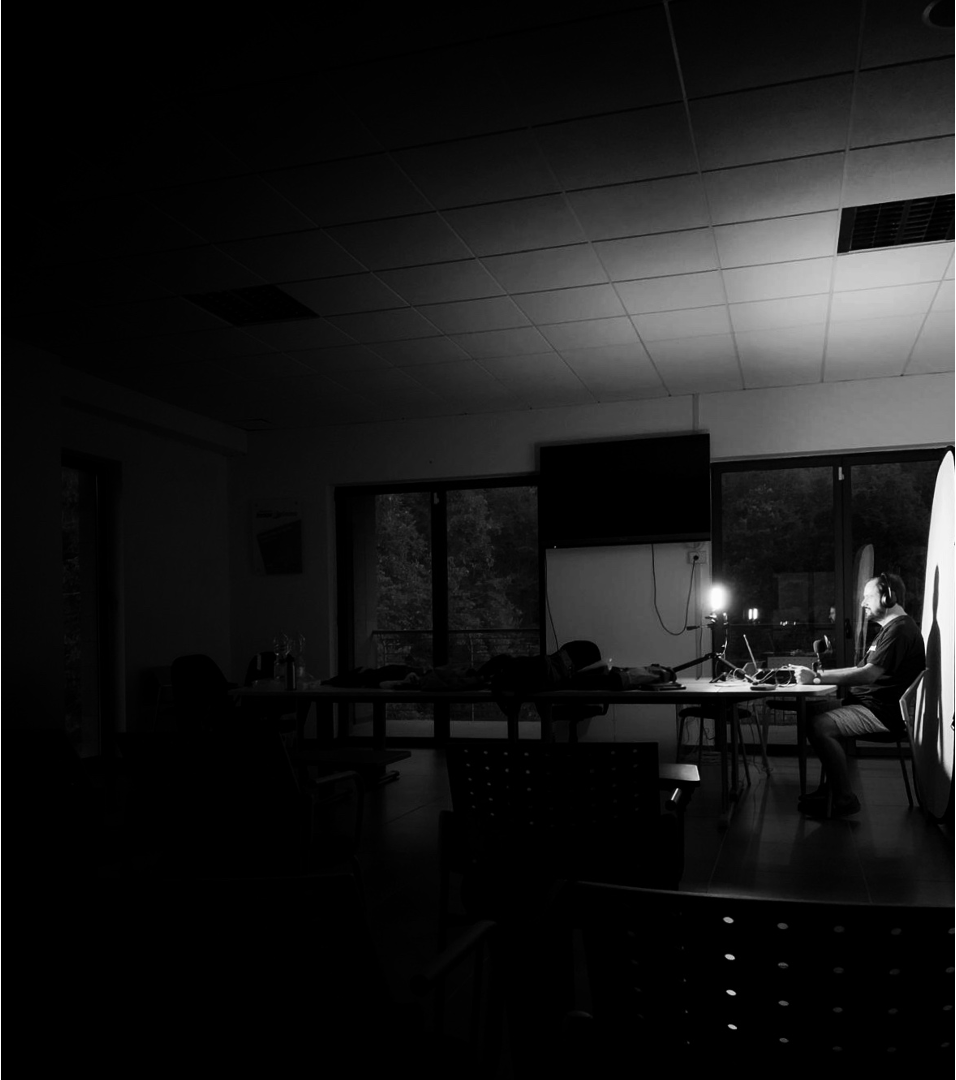
I learned an incredible amount of things, and I did it in public, sharing it with the community every week.
Moreover, I had the honor of meeting some of the brightest people in the international Deep Tech landscape: some because they joined the podcast as guests, some as mentors, some as friends to share ideas with.
And some as all of those things together.
One thing I found interesting was that, initially, I thought our community would be made up predominantly of founders. Instead, more and more investors and industry leaders joined.
A community that wanted to stay tuned into the state of the art at the intersection of company building and capital stack design.
After one thousand days, Deep Tech Catalyst has delivered more than 2,500 minutes of educational content, as I navigated across a wide range of macro-verticals, including energy, materials, specialty chemicals, semiconductors, quantum, space, defense, robotics, healthcare, mining, water, and agrifood.
After a while, it became clear that not all projects align with VC return expectations, since deep tech is truly heterogeneous, and almost every case has to be analyzed on its own as an independent scenario.
However, I discovered that, across industry, technology, geography, and also team composition conditions, there are similar patterns that I started identifying, mapping, and sharing on the platform.
Moreover, some recurring themes on our podcast led to the development of thematic areas at the intersection of capital and Deep Tech.
If I had to distill them even further to capture the common language DTC has built, I would frame it around five core areas:
Capital → Commercialization → Economics → Scale-Up → Exit
All of them are continuously shaped by execution, team, milestones, customers, supply chains, regulation, and strategic partnerships.
Preparing for the next chapter…
At this point, after everything I have built over the past 1,000 days, I wanted to take stock of the journey.
So I returned, as I often do, to a specific quote from Reid Hoffman:
“If you are not embarrassed by the first version of your product, you’ve launched too late.”
And fortunately, there has been plenty of embarrassment here, beyond my strong Italian accent. Quite a lot of it. There has also been a bit of anxiety, but also a lot of enthusiasm and fun.
However, times are changing and I feel I have to evolve. Deep Tech today is not the same Deep Tech it was in 2023.
In a short period of time, I have had the pleasure of observing the change not only in the markets, but also in the very conception of Deep Tech as a discipline.
It has become less and less a term associated with complexity and unfeasibility, and little by little it is beginning to resonate again as a word, as a trend, as an ecosystem, as a way of doing things, increasingly understood and widespread among people in the industry.
Many more projects are being born. And solid ones.
Many more incubators, accelerators, and funds are moving in this direction, because it is inevitable that, with Deep Tech being so important, there would be support from everything that represents the market’s response to the enormously important unmet needs that Deep Tech can address.
However, these changes also bring with them the need to adapt the format, so I have decided to pause the production of Deep Tech Catalyst for a few weeks, with new objectives in mind, different, more modern, and better suited to changing times.
In the meantime, The Scenarionist will continue at full speed, exploring scenarios, case studies, and analyses every week.
There are a lot of new things coming soon, including new ways for builders and backers to catalyze opportunities, collaborate, succeed together, and create a better future.
But I wanted to take a moment to thank you from the bottom of my heart for joining me, week after week, on this wonderful journey.
1,000 days have passed, 130 episodes, but this is only the beginning of something that has yet to come out.
And I am more determined than ever to discover it together with you all.
Warmly,
Nicola